
Typhula culmigena
Taxonomy
Main synonym
Common names
Tipula de esporas con forma de corazón.
Geographic references:
Interactive map with data from GBIF.



Morphological Features:
Basidiocarp with a characteristic clavate shape, showing two perfectly delimited parts: an upper portion which is the proper clavate head, and a stipe-like lower portion. The clavate upper zone is pure satiny white in young specimens, adopting darker tones as the specimen approaches senescence, with an apex that is generally obtuse, never pointed, and of very small size; this part of the basidiocarp rarely exceeds 1.5 mm. The total size of the basidiocarp in this species usually ranges between 1.5 and 2.5 mm, which greatly hinders its detection.
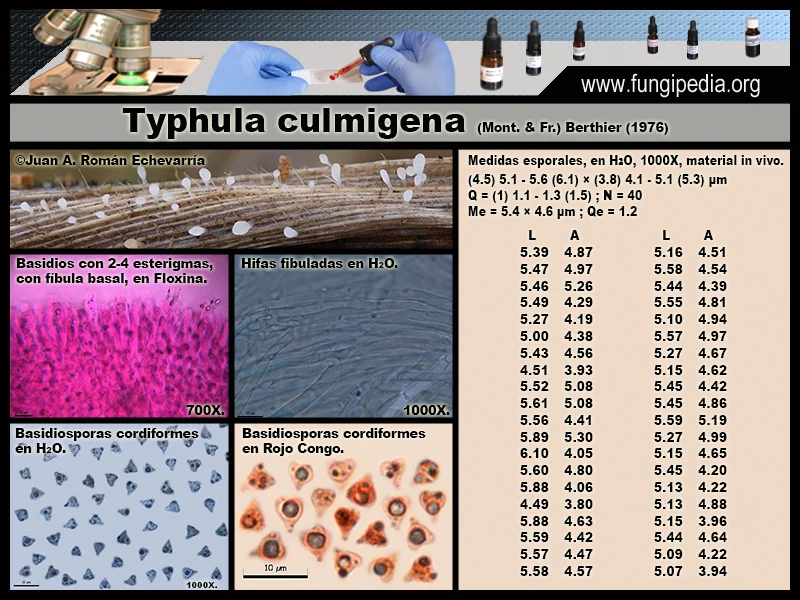
Hymenium immersed in the surface of the upper portion or clavate head, while the stipe zone is sterile; it produces characteristic heart-shaped (cordate) basidiospores, and clavate basidia with a basal clamp connection (see microscopic features).
Stipe generally shorter than the clavate head or occasionally similar in length, whiter and more translucent than it, and similarly tending to darken at maturity. It is cylindrical, smooth, and glabrous, with a surface provided with gelatinized hyphae; it attaches directly to the substrate without the presence of a sclerotium.
Flesh completely insignificant, without any noteworthy odor or taste.
Habitat:
The small size of such species makes them difficult to locate; however, we believe this particular one is not as uncommon as it appears. It generally fruits in more or less numerous groups on various decaying or senescent herbaceous stems. We do not believe it has a preference for a specific season for fruiting; provided the necessary conditions are met, we have found it in both spring and autumn. Its saprotrophic behavior on grass means that referencing a specific forest type for its location is not relevant.
Observations:
A minute species very difficult to differentiate macroscopically from other species of its genus; however, microscopically this task is straightforward due to its characteristic heart-shaped spores. It is also characterized by the absence of a sclerotium and the presence of a differentiated stipe provided with gelatinized hyphae. All these features allow it to be distinguished from related species such as Typhula quisquillaris or Typhula graminum, which in both cases differ in spore shape, possess a sclerotium, and have hairs on the stipe.
Microscopy of Typhula culmigena