
Typhula contorta
Taxonomy
Main synonym
Common names
Not available
Geographic references:
Interactive map with data from GBIF.



Morphological Features:
Fruiting body hollow, of absolutely irregular and variable shape, lacking a specific typical form, and often appearing malformed; some specimens are horn-shaped or resemble a rooster's comb, never acquiring stylized or elongated forms. Surface smooth and glabrous, ochraceous in color, only becoming powdery due to sporulation, with the base always thick and bearing whitish mycelial fibrils, and the apex generally obtuse and rounded.
Hymenium smooth and of the same color as the rest, immersed in the external surface of the fruiting body, developing a whitish pruinose coating upon maturation since its spores in mass are white; it occupies almost the entire fruiting body except for the sterile base.
Stipe absent as such; despite its basal region being sterile, no differentiation is apparent between various regions of the fruiting body.
Flesh insignificant as the fruiting body is completely hollow from inception, ochraceous in color, somewhat firm when young, later becoming soft, without any noteworthy odor or taste.
Habitat:
This is an eminently lignicolous species; it generally fruits on wood, woody debris, or fallen branches of various broadleaf trees. It is a relatively uncommon species that fruits preferentially during autumn. Our collection was made in November on a fallen branch of Alnus glutinosa (alder). It may grow solitary, but it is more common to find several individuals of the species on the same branch.
Observations:
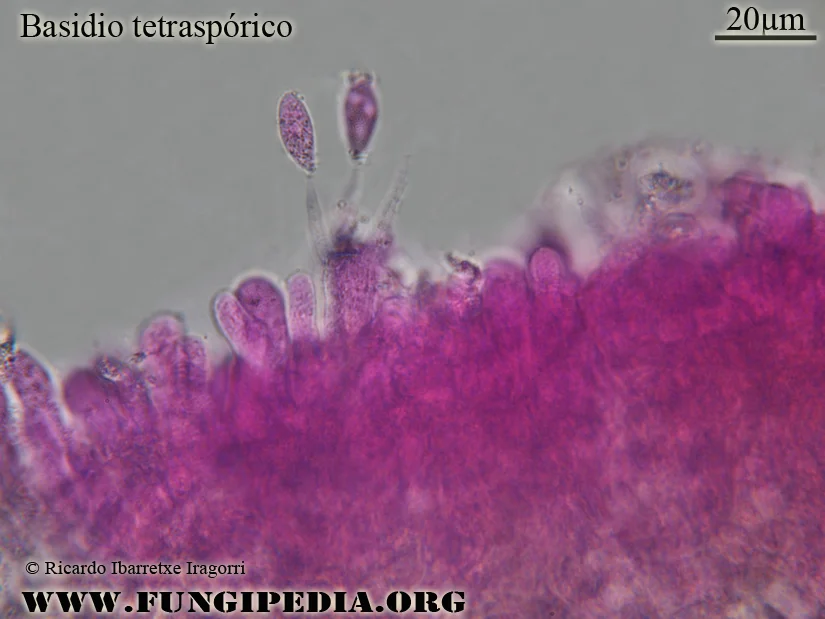
This is a recently described species, long considered merely a variety of Typhula fistulosa, recognized as a distinct species by Olariaga (2012) based on several differences; its macroscopic distinction is evident, but it also exhibits microscopic differences such as spore size. Given its somewhat amorphous and malformed development, it is a species unlikely to be confused with others; the aforementioned Typhula fistulosa typically develops stylized and elongated fruiting bodies shaped like slender clubs, whereas other species of the genus are minute in size, pale-colored, or hyaline.
Microscopy of Typhula contorta