
Typhrasa gossypina
Taxonomy
Main synonym
Common names
Not available
Geographic references:
Interactive map with data from GBIF.


Morphological Features:
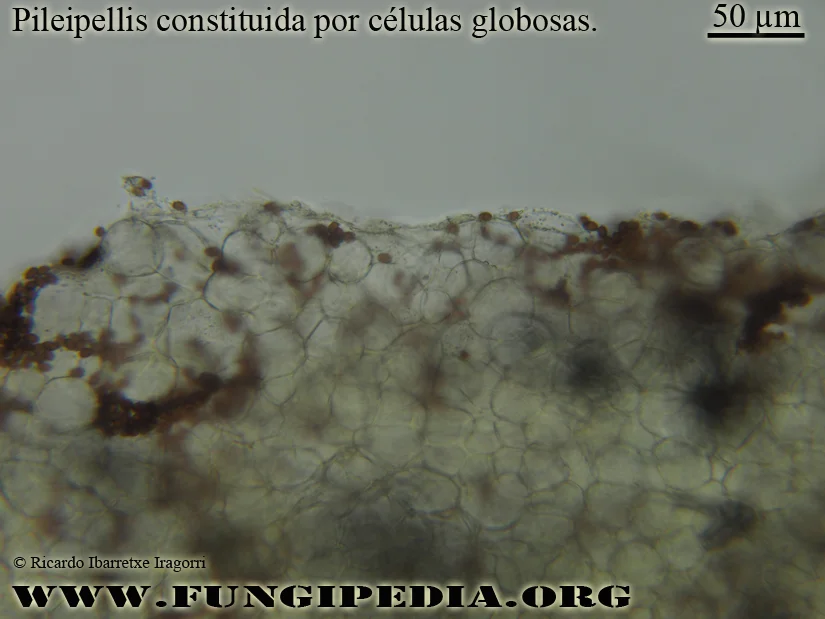
Pileus of notable size for the genus; well-developed specimens can easily exceed 5 cm in diameter. Campanulate in young specimens, later convex and finally flattened, with the center prominently marked by an obtuse umbo. The rugulose cuticle is reddish-brown in younger specimens, turning ochraceous with age; as a hygrophanous species, it adopts much lighter tones upon drying. The entire surface is initially covered with volatile veil remnants, which over time become only appreciable at the margin. The margin is incurved when young, later becoming extended and quite regular.
Lamellae adnate and moderately spaced apart, initially pale, whitish or cream-colored, turning ochreous and finally more or less dark grayish-brown upon maturing. The lamellar edge is often irregular or lacerate and usually whitish.
Stipe usually elongated relative to the pileus, cylindrical but rarely straight, rather curved, with a base slightly thicker than the apex. Floccose and pruinose at the apex, sometimes bearing some not very prominent longitudinal striations. Much paler than the pileus, whitish, and fistulous or hollow.
Flesh thin, pale in color, whitish or cream, without a distinctive odor and practically tasteless.
Habitat:
This is a species that develops saprotrophically on leaf litter or humus, and also generally on woody or herbaceous debris, usually under various broadleaf trees, oaks, beeches, or riparian trees as well. Within our area of study, it appears with relative frequency but is generally not abundant at all, typically occurring solitary or more commonly in small groups of a few specimens. It shows no preference for a specific time of year; we have located it both in spring and during autumn.
Observations:
Species belonging to the recently established genus Typhrasa, historically known as belonging to the genus Psathyrella, being one of the largest species within it. Aside from its size, it is characterized by its rugulose pileus with a very prominent veil in young specimens that tends to disappear, as well as its whitish stipe which also bears veil remnants when young. It could be confused with some species, such as the fair edible Lacrymaria lacrimabunda, which has a darker spore print and characteristic tears, or with Psathyrella maculata, which lacks such a rugulose pileus and differs in spore size; other species with similar characteristics do not reach the size of this one.
Microscopy of Typhrasa gossypina