
Tuber panniferum
Taxonomy
Main synonym
Common names
Trufa aterciolpelada, trufa lanosa.
Geographic references:
Interactive map with data from GBIF.
Morphological Features:
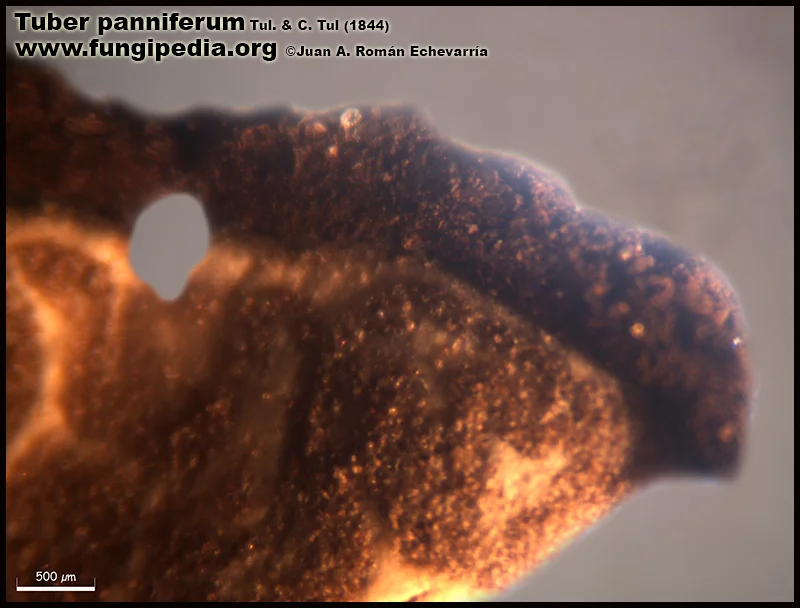
Fruitbody with the typical shape of species in its genus, tuber-like or small potato-shaped, often subglobose and rarely regular, in most cases bearing various protuberances or even lobed. Rather small in size, diameter usually does not exceed 4 cm; in our case, collected specimens ranged between 1 and 3 cm. It exhibits a color ranging from brown to more or less dark tawny, a hue imparted by its abundant woolly coating, with the tissue beneath the hairs being darker than the hairs themselves. Another relevant feature is the presence of a distinct basal cavity at the mycelial attachment zone, which tends to extend into the gleba.
Peridium pseudoparenchymatous, composed of thick-walled and pigmented cells, adherent to the gleba, dark brown in color, and entirely covered by abundant, thick-walled, multiseptate brown hairs that give the entire ascocarp a woolly appearance. It usually has a moderate thickness, not exceeding 300 μm in any case (see microscopic features).
Gleba compact, whitish in young specimens, composed as is typical of two types of veins; some retain the same whitish tone upon maturation, while others evolve in color with specimen maturity, first turning greyish and finally becoming greyish-brown.
Flesh quite firm and hard, composed of the gleba itself, lacking the hardness of Tuber excavatum but firmer than edible truffles, with a relatively intense truffle-like odor that becomes somewhat unpleasant in more mature specimens, and a rather insipid flavor reminiscent of unsalted sunflower seeds.
Habitat:
This is a hypogeous species that fruits buried in predominantly calcareous soils; where it occurs, multiple individuals are generally found together, rarely isolated. It exhibits a Mediterranean distribution, being more commonly encountered in the southern Iberian Peninsula, typically forming ectomycorrhizae with holm oaks (Quercus ilex). In contrast, it is less frequent in the north, where it shares habitat with Tuber aestivum. Its preferred collection period is late spring and summer, although immature specimens can be found practically year-round. Several collections of this species were used to compile this description, both from Navarre and the province of Álava, all forming ectomycorrhizae with Quercus ilex.
Observations:
Due to the hardness of its flesh, lack of flavor, and presence of external hairs, this truffle species is not used for culinary purposes and is considered a rather mediocre edible. The peculiar characteristics of the ascocarps of this species, particularly its woolly coating and basal cavity, make it one of the most easily identifiable macroscopically within the genus Tuber; it is practically unmistakable. Microscopically, it is characterized by asci containing up to 8 spores, which are ornamented with conical spines. Other species, such as those within the Tuber rufum complex, possess a papillate peridium, but never with a woolly coating.
Microscopy of Tuber panniferum