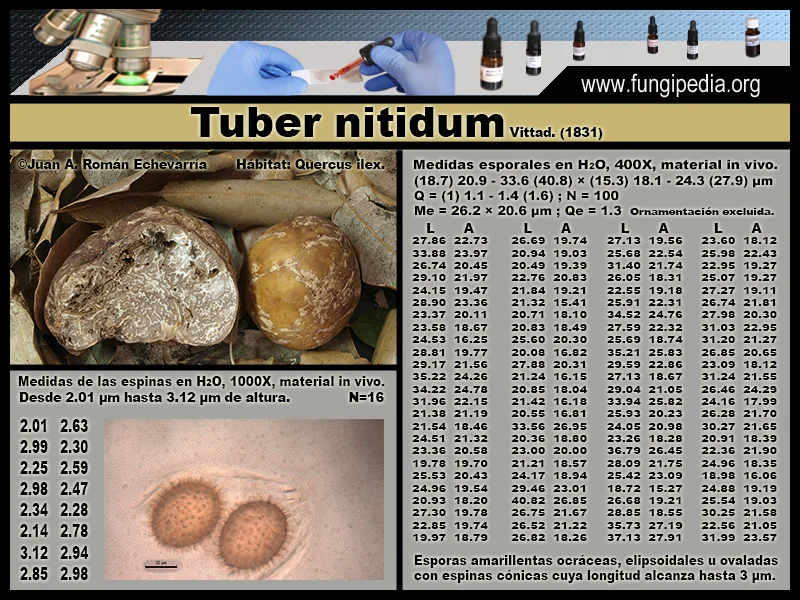

Tuber nitidum
Taxonomy
Main synonym
Common names
Trufa de la encina, trufa brillante.
Geographic references:
Interactive map with data from GBIF.



Morphological Features:
Fruiting body rather small for the genus, with the diameter of collected specimens ranging from 1 to 3 cm. It exhibits the typical tuberous or small potato-like shape common in Tuber species, somewhat variable, sometimes subglobose and at other times more irregular, bearing protuberances but scarcely lobed. The color is equally variable within the ochre spectrum, ranging from light ochre to tones approaching brown in more mature specimens. It lacks a true basal cavity as seen, for example, in Tuber excavatum, but many specimens do feature a characteristic wrinkle or fissure in the region closest to the mycelial attachment.
Peridium plectenchymatous, smooth and glabrous, lacking hairs or true papillae as found in related species, perhaps slightly pruinose. It is quite thick, potentially exceeding 500 μm in thickness, and practically inseparable from the gleba. Although nearly white specimens may be encountered when very young and immature, it is more common for them to be ochraceous, turning to nearly brown tones in older specimens.
Gleba compact, firm, and hard, whitish in the initial developmental stage, acquiring pinkish to ochre tones, and darkening considerably upon maturation. It features whitish veins that retain a lighter tone than the remainder of the gleba even when mature.
Flesh, which is actually the gleba itself, very firm, with a pleasant truffle-like odor in young specimens that intensifies with maturation, becoming somewhat unpleasant at the end. Its flavor is not unpleasant, reminiscent of nuts in young specimens.
Habitat:
A species that fruits quite abundantly in the holm oak forests of southern Iberia, associated with Quercus ilex although not exclusively. It is also recorded under other trees such as Quercus rotundifolia or Quercus pyrenaica, however, it is less prolific in the north. It typically fruits in more or less numerous groups, hypogeously, developing throughout spring and reaching optimal maturity during summer and early autumn. Our collection was made in the province of Álava, where it has also been located under Quercus ilex.
Observations:
An edible species not highly prized, partly due to its small size and somewhat firm flesh. It is a species that can be placed within the Tuber rufum complex; some authors previously considered it a variety thereof, but it currently holds its own taxonomic status thanks in part to DNA analyses. Tuber rufum, Tuber ferrugineum, and Tuber pustulatum are closely related species that are highly complex to differentiate from one another. Even microscopic analysis reveals no differences, partly due to the high variability in spore size and shape among these species, even between specimens harvested from the same mycelium. However, all three possess a papillose peridium, making Tuber nitidum the only species distinguishable macroscopically within this complex due to its completely smooth peridium.
Microscopy of Tuber nitidum