
Tuber mesentericum
Taxonomy
Main synonym
Common names
Trufa de verano maloliente
Geographic references:
Interactive map with data from GBIF.



Morphological Features:
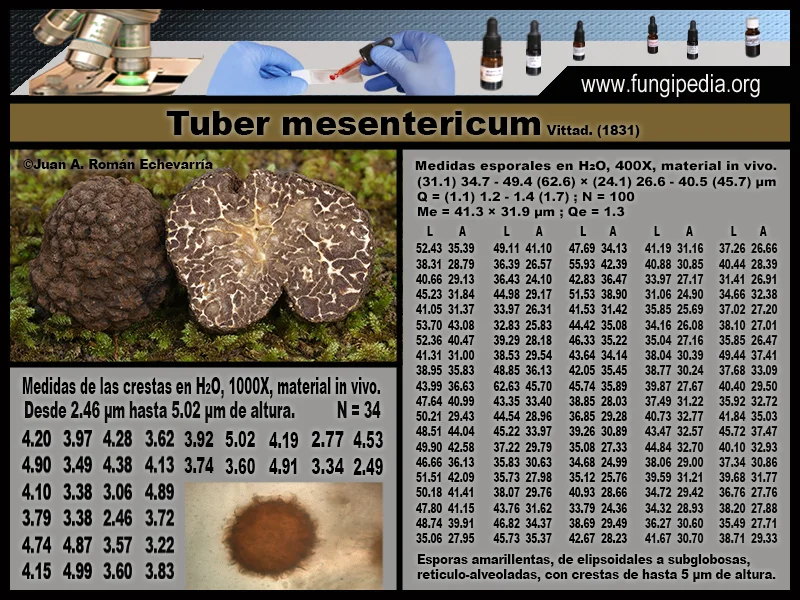
Fruit body practically spherical in younger specimens, but adopting somewhat variable shapes as it grows, oblong and irregular, without pronounced bumps, with the presence of a characteristic cavity at the base. It is rather small in size, usually between 2 and 4 cm in diameter, occasionally reaching 6 or 7 cm. Dark brown or black, quite uniform in color. It does not present any dehiscence and is entirely covered with warts.
Peridium very dark brown or practically black at times, entirely covered by pyramidal warts measuring 3 to 6 mm wide at their base in our collection, tightly packed, even with some grooves, and projecting upward less prominently than other similar species, sometimes flattened, though mostly ending in a point.
Gleba compact, solid, rather dark brown, but provided with whitish veins that usually do not change color with maturity; it is typical, especially in young specimens, for the veins to exhibit a radial convergence toward the basal area.
Flesh compact, firm, with a strong and pronounced, rather unpleasant odor, reminiscent of tar when collected, but acquiring a camphoraceous undertone in enclosed spaces; its flavor is strong and slightly bitter, though by no means as unpleasant as the smell.
Habitat:
Like all its congeners, this is a hypogeous species that fruits underground at shallow depth, forming cracks in the soil, and may even sporadically breach the surface. It is a mycorrhizal species associated with various broadleaf trees such as beech, hazel, oak, or holm oak, creating a vegetation-free area where it grows, colloquially termed a "brûlé" (burnt patch); our collections are from beech (Fagus sylvatica) and hazel (Corylus avellana). It is an early-fruiting species that dislikes cold, fruiting from spring onwards and throughout the summer months, often sharing habitat with Tuber aestivum.
Observations:
A species of summer truffle characterized by an unpleasant odor of tar or camphor, a strong flavor, and a dark brown gleba with white veins. For a long time, due to microscopic similarities, this species was synonymized with Tuber aestivum, which has a pleasant aroma and taste; phylogenetic studies have demonstrated what was otherwise obvious: that they are two distinct species. In addition to organoleptic features, the described species possesses a typical basal cavity absent in Tuber aestivum. It is a mediocre edible. Tuber uncinatum, which is very similar, is actually an autumn form of Tuber aestivum.
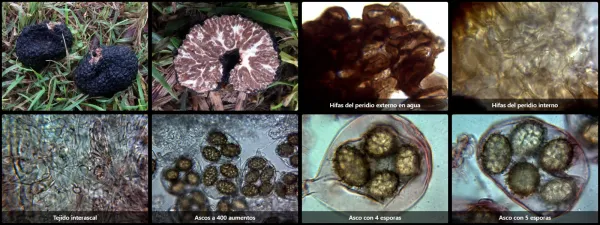
Microscopy of Tuber mesentericum