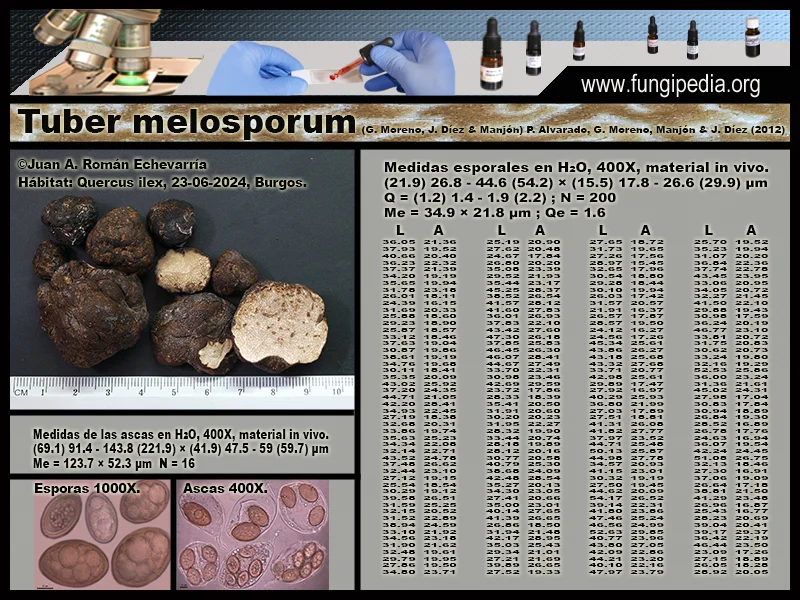
Tuber melosporum
Taxonomy
Main synonym
Common names
Not available
Geographic references:
Interactive map with data from GBIF.





Morphological Features:
Fruiting body with the typical shape usually adopted by truffles, resembling a small, more or less spherical or oblong tubercle, irregular but without pronounced deformities, although it is not uncommon for it to exhibit some cracks. It has a predominant brown color, more or less dark, with a reddish tinge in some specimens, and in others more distinctly blackish, sometimes even mottled with darker areas, showing considerable variability in this regard. It is not a species characterized by large size; the diameter usually ranges between 1 and 4 cm, although exceptionally larger specimens may occasionally be found.
Peridium externally composed of more or less regular plates in patches, which are flat rather than pyramidal as seen in other Tuber species, reddish-brown to blackish in color. It consists of two overlapping layers without a clearly defined boundary separating them: an outer pseudoparenchymatous layer formed by angular hyphae, and an inner, more intricate layer with interwoven cylindrical hyphae. The total thickness of the peridium can vary between specimens, ranging from 150 to 300 micrometers.
Gleba generally compact, fleshy, and firm; initially whitish to slightly creamy in color, gradually developing light brown tones upon maturation. Sterile white veins are present throughout all developmental stages, and darker grayish venation may also be observed in more mature specimens. Asci are predominantly spherical to pyriform, varying according to the number of spores they contain, which ranges from 1 to 6, with 3 or 4 being most common. The spores are smooth and lack ornamentation, a feature exceptional within the genus; however, scanning electron microscopy reveals slight surface rugosities.
Flesh essentially absent beyond the gleba itself, which is firm and compact. The odor does not differ significantly from that of other truffles such as Tuber aestivum, though it is less pronounced than that of Tuber melanosporum.
Habitat:
Tuber melosporum is a strictly hypogeous species that fruits underground and can only be located with the assistance of trained dogs. It tends to fruit during the same months and in similar locations as Tuber aestivum. This is an infrequent species with very few documented records; to date, it has only been reported from the Iberian Peninsula and Italy (specifically Sardinia). The majority of records originate from Castile and León, including our own collection gathered in the province of Burgos on June 23, 2024. It was found fruiting in a holm oak (Quercus ilex) woodland, a preferred but not exclusive habitat for this species.
Observations:
This species represents an exceptional case within the genus Tuber, as it is the only member of this genus possessing smooth, non-ornamented spores. This characteristic facilitates its identification; however, it initially led to its classification within the genus Picoa. Subsequent phylogenetic analyses unequivocally demonstrated that it truly belongs to Tuber. Morphologically, this species more closely resembles the Tuber rufum clade, which encompasses several species that are notoriously difficult to differentiate. Other co-occurring species, such as Tuber aestivum, possess pyramidal rather than flat plates. It should not be confused with Tuber melanosporum, a distinctly different winter fruiting species with which it shares only a similar name.
Microscopy of Tuber melosporum