
Tuber magnatum
Taxonomy
Main synonym
Common names
Trufa blanca, tartufo bianco d'Alba.
Geographic references:
Interactive map with data from GBIF.



Morphological Features:
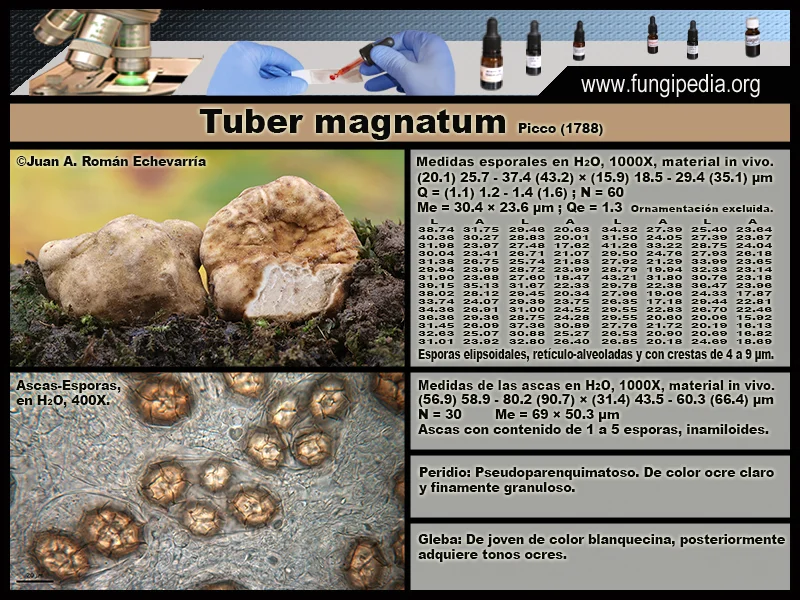
Fruit body bearing the characteristic shape of species within its genus, resembling small buried potatoes; however, this tuberous form is usually not highly regular, as it commonly exhibits protrusions and is irregularly lobed, varying among specimens, with some assuming a turbinate shape. Size is highly variable; most specimens do not exceed 6 cm in diameter, but occasionally individuals over 10 cm are found, weighing up to 800 g, which are typically auctioned. Despite the common name "white truffle," in contrast to the black ones (Tuber melanosporum), it does not possess this color; rather, it is light ochre, sometimes with slight olive-gray tones.
Peridium relatively thin, firmly attached to the gleba and thus not separable from it; primarily light ochre in color, occasionally slightly greenish, but never white. When examined closely with a hand lens, a fine granularity is discernible, though it appears smooth to the naked eye.
Gleba compact and firm, highly variable in color depending on the specimen's maturity stage; initially whitish in early developmental stages, later acquiring various ochre or reddish-brown tones, and occasionally pinkish or yellowish hues. It consistently features lighter-colored veins that distribute irregularly and sinuously throughout the gleba.
Flesh consistent and firm, possessing a very intense odor characteristic of truffles, which some compare to certain gaseous compounds, and which may be overwhelming to unaccustomed noses. Its flavor is likewise intense yet highly pleasant, characteristic of the species, representing a complex blend that is difficult to define; compared to the black truffle, the species described here typically exhibits a slightly more alliaceous nuance.
Habitat:
This is a hypogeous species; it is sometimes found just a few centimeters below the soil surface and at other times much more deeply buried. It favors calcareous, clayey, stone-free, compact soils with abundant vegetation, generally in areas where water runs. It is highly specific to certain areas of the Italian Piedmont and the Istrian region, shared by Slovenia and Croatia. It typically forms symbiotic associations with various broadleaf trees, ranging from oaks and holm oaks to lindens and hazels. Its fruiting period extends from early autumn through winter, and its yield is generally linked to summer rainfall.
Observations:
We are undoubtedly dealing with the most expensive and highly prized edible fungal species in the world; its market price is typically astronomical, varying according to annual productivity but consistently reaching several thousand euros. A study by French scientists has recently been published claiming successful cultivation; to date, it has only been harvested in the wild. Due to its distinctive organoleptic and macroscopic characteristics, it is a species that can be readily distinguished, although occasionally unscrupulous vendors attempt to pass off Tuber borchii as a substitute. The latter is a much smaller species with a pronounced alliaceous odor and flavor; it is a good edible but of inferior quality compared to the species described in this entry.
Microscopy of Tuber magnatum