
Tuber macrosporum
Taxonomy
Main synonym
Common names
Trufa negra lisa, trufa de grandes esporas.
Geographic references:
Interactive map with data from GBIF.

Morphological Features:
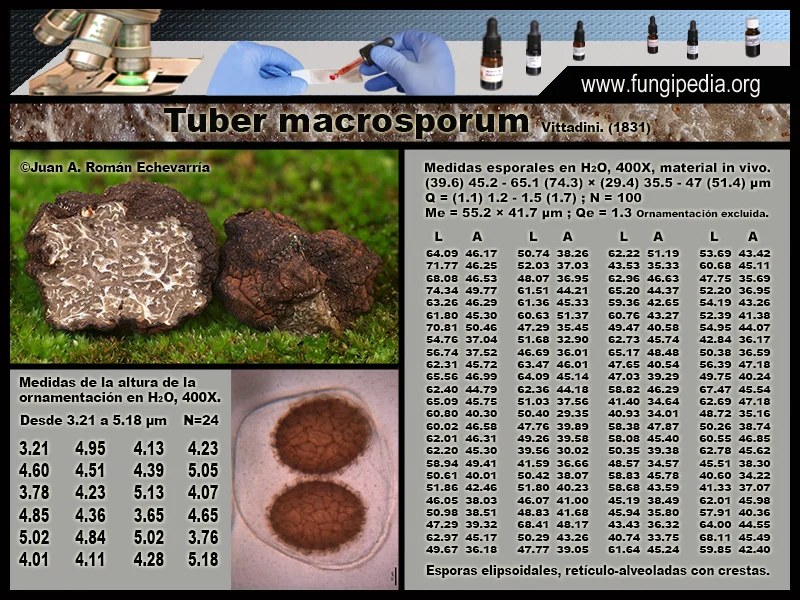
Fruiting body that is generally rather small in size compared to other related species, with a diameter that rarely exceeds 6 cm, although specimens between 1 and 4 cm are commonly found, as in our collection. Its shape is typical of Tuber species: variably irregular and tuberculate, sometimes subglobose or even globose, and at other times more lobed or bearing various protuberances. It occasionally features a small basal cleft that does not develop into a pit as seen in other species of the genus. Its predominant color is a more or less dark reddish-brown, although this aspect is also somewhat variable; even a single specimen may exhibit different shades.
Peridium adherent to the gleba and therefore inseparable from it. It is composed of plates that are not pyramidal but entirely flat, giving the ascoma an initially smooth and cracked appearance upon first glance, which is somewhat misleading since it is actually formed by perfectly delimited polygonal plates. It is dark brown with reddish or rust-colored tints, never reaching black.
Gleba compact and cavity-free. As is typical, it is formed by two types of veins: light-colored, almost whitish veins that darken only minimally upon cutting, and contrasting greyish-brown veins that evolve with the degree of maturation into purplish tones and finally dark brown/blackish hues.
Flesh firm, consisting of the gleba itself. It possesses an intense truffle aroma with clear alliaceous notes, quite pleasant for those accustomed to the scent of truffles. Its flavor is analogous and highly interesting from a culinary standpoint; in our opinion, it falls midway between Tuber magnatum and Tuber borchii.
Habitat:
This study is based on three collections of the species: two from the same area in a Quercus robur forest, and a third from another location featuring both Quercus robur and Corylus avellana, all within the province of Álava. In Italy, this species is typically associated with Tuber magnatum regarding both habitat and fruiting period, generally occurring in autumn, although Tuber macrosporum tends to appear slightly earlier. In our case, it shares both habitat and seasonality with Tuber uncinatum, the autumnal form of Tuber aestivum. This hypogeous species was located with the aid of trained dogs; it is a very rare species not previously recorded in our region.
Observations:
This represents the first record for the Basque Country flora and the second at the national level for this rare truffle species. Nevertheless, it is quite easy to identify; macroscopically, it is characterized by its flat, non-pyramidal warts and dark reddish-brown color, distinguishing it from black truffles on one hand, and from species of the Tuber rufum group (which have areolate or smooth peridia) on the other. Furthermore, the enormous size of its asci and spores, practically visible with a simple hand lens, makes it unmistakable. It is a choice edible that is beginning to be marketed from Italy, albeit in very limited quantities, possessing a pleasant truffle aroma and flavor with garlic notes.
Microscopy of Tuber macrosporum