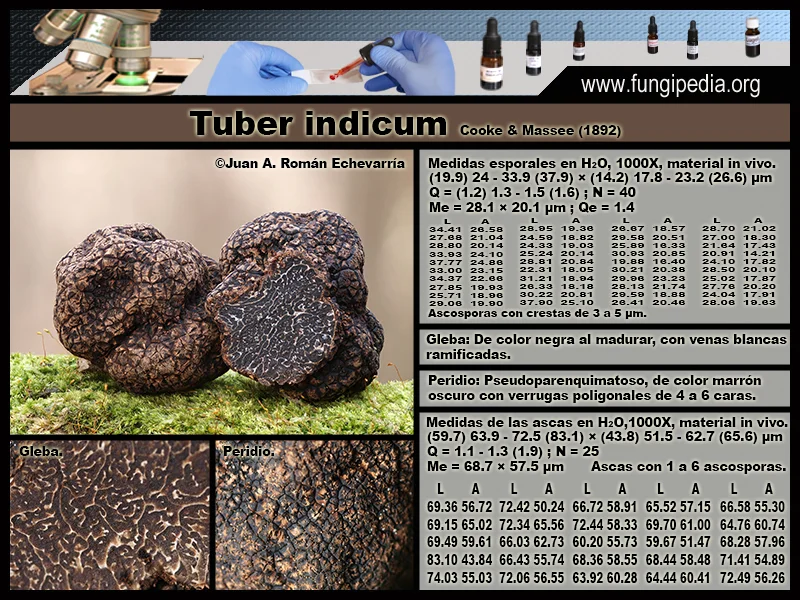
Tuber indicum
Taxonomy
Main synonym
Common names
Trufa negra china
Geographic references:
Interactive map with data from GBIF.





Morphological Features:
Fruiting body presenting the typical tuberculate form, resembling a small potato as seen in all Tuber species, generally quite spherical. It is not a species that tends to exhibit excessive protrusions or shape irregularities, though it may occasionally be slightly lobed. It has a fleshy appearance despite being a relatively small species, generally measuring between 1 and 5 cm in diameter, though it can occasionally be somewhat larger. Its color ranges from brown to dark chestnut tones, with a tendency to darken or blacken in patches; although it appears black when sold in jars with liquid, it is not actually black once cleaned.
Peridium pseudoparenchymatous, composed of clustered globose to ovoid cells resembling certain plant structures, though not truly parenchymatous. It lacks the double-layered peridial structure found in other Tuber species, being completely adherent to the gleba and thus inseparable from it. Brown to chestnut in color, with some darkish blotches in older specimens. Composed of numerous polygonal warts with 4 to 6 faces and measuring 2 to 4 mm at the base, with an apex that is not pointed but rather flattened or worn.
Gleba generally fleshy in appearance, compact, without any cavities. In early developmental stages, when fully immature it is whitish, gradually darkening until at maturity it adopts a blackish tone with purplish hues, closely resembling the typical appearance of the gleba in Tuber melanosporum. It possesses numerous whitish sterile veins that persist upon specimen maturity. It contains asci bearing 1 to 6 spores each; these are brown and ornamented with spines fused at the base that do not form a reticulum. The spores are ellipsoidal; these characteristics can be observed in our microscopy section.
Flesh Compact but less firm than other congeners, even somewhat corky, with a rather faint, mild truffle odor, and a fairly poor flavor compared to other truffles.
Habitat:
This is undoubtedly a species that is cultivated and commercially sold worldwide, although its region of origin is typically southwestern China, especially in Yunnan, Sichuan, and Tibet. In the wild, it also grows in other regions such as India, generally preferring alkaline and elevated soils above 1800 meters, with recorded habitats under both conifers and various broadleaf trees. Its preferred fruiting period is during the winter months, from November to March; it is the typical Asian winter truffle.
Observations:
This is a species that is often marketed under the grandiose name of black truffle; its market price barely reaches 30 euros/kg due to its very low quality. However, some have attempted to pass it off as Tuber melanosporum, a species of indisputable gastronomic quality whose price easily exceeds 600 euros/kg. Both internally (gleba) and in certain microscopic aspects, they share some similarities, but there are also notable differences between them: the aroma is very faint, whereas in T. melanosporum it is extraordinary; its spores are less elongated than those of the true black truffle, and its peridium is browner.
Microscopy of Tuber indicum