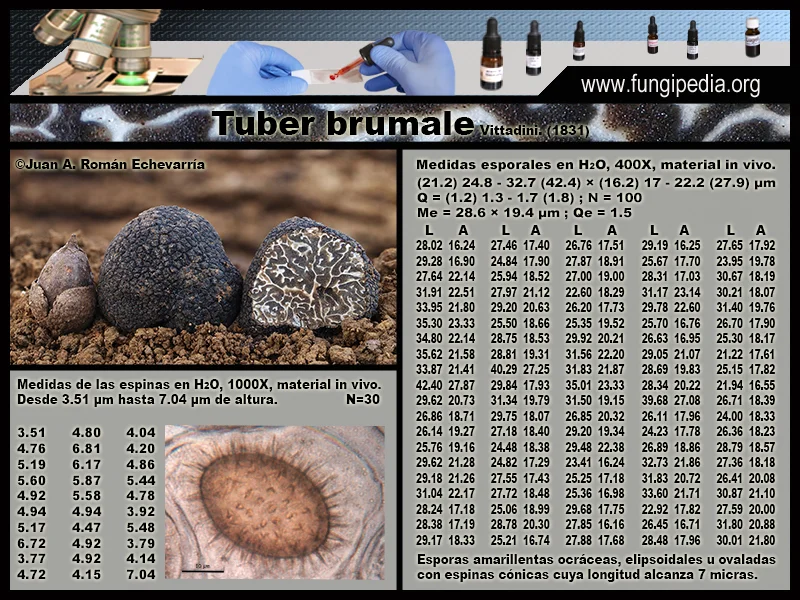
Tuber brumale
Taxonomy
Main synonym
Common names
Trufa de invierno, neguko boilur, tofona negra.
Geographic references:
Interactive map with data from GBIF.





Morphological Features:
Fruiting body more or less globose in younger specimens, growing irregularly and developing protuberances or lobes in mature specimens, lacking a specific definable shape other than being described as tuberiform. The average size of a mature specimen is typically around 4 to 5 cm in diameter, with some reaching up to 10 cm. Although initially lighter in color upon emergence, it rapidly turns black, making this dark coloration the most commonly observed state.
Peridium thin, composed of black warts up to 3 mm in size, flattened at the apex and longitudinally striated. It is highly fragile and not adherent to the gleba, often detaching during brushing.
Gleba white in young and immature specimens, turning greyish with maturity and finally dark grey. It features broad, prominent veins that remain white regardless of the specimen's maturity stage.
Flesh firm and compact, with a pleasant taste and the characteristic aroma of truffles, although less intense than that of Tuber melanoposporum.
Habitat:
As its name suggests, this is a winter-emerging species, with the preferred harvesting months ranging from January to March. Even in plantations of mycorrhizal trees, it shares habitat with Tuber melanosporum. Beyond this common habitat, it is also frequently found under lime and hazel trees. It may occur without Tuber melanosporum in moister locations unsuitable for the latter, or in areas with a less alkaline pH. It is a hypogeous species that grows underground, generally requiring trained dogs for location.
Observations:
This species is a choice edible despite lacking the intense aroma of other truffles, which accounts for its notably lower market value. It is a highly variable species that has given rise to multiple varieties, characterized by its fragile, warty peridium that is not adherent to the gleba and detaches upon handling, as well as its broad veins that are consistently white. Tuber melanosporum is a certainly similar species with which it shares habitat and fruiting season; however, it possesses a notably more intense aroma, its peridium is indeed adherent to the gleba and thus does not detach easily, and its veins are much narrower.
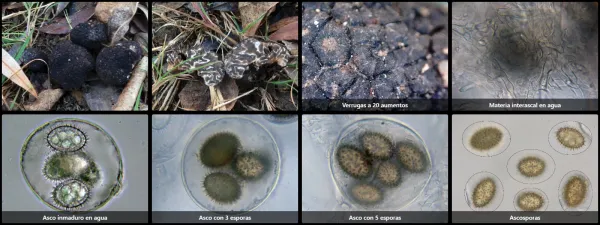
Microscopy of Tuber brumale