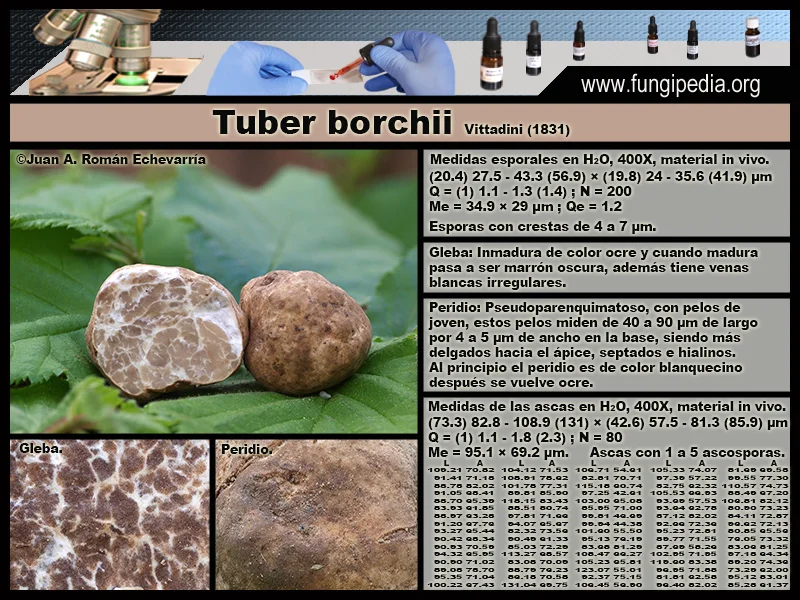

Tuber borchii
Taxonomy
Main synonym
Common names
Trufa de marzo, trufa blanca de primavera, trufa de pino, trufa blanchiatto.
Geographic references:
Interactive map with data from GBIF.



Morphological Features:
Fruiting body exhibiting the typical tuberculate or small potato-like shape characteristic of truffles; sometimes uniform, at other times more irregular with small swellings or protuberances, although a spherical to ovoid shape is most frequent, lacking a basal cavity. It is a small-sized truffle, with a diameter typically ranging from 2 to 4 cm, though specimens measuring 6 or 7 cm may be found sporadically. Young specimens are pubescent due to the presence of hairs that gradually disappear upon maturation, eventually becoming glabrous.
Peridium adherent to the gleba, not easily separable from it; smooth, non-warty, ranging from pubescent to glabrous. Highly variable in color, initially typically beige, occasionally with a yellowish tinge, later tending to develop reddish blotches, and eventually becoming ochre or even reddish-brown at maturity.
Gleba closed, solid, lacking any type of cavity; equally variable in color. When young, light-colored or beige, darkening with maturity to reddish-brown or brown, occasionally with a purplish tinge. It possesses whitish veins that do not change color, fewer in number than in other truffles and non-confluent, arranged irregularly instead.
Flesh compact and firm, emitting an intense, pleasant truffle odor with a distinct garlic tinge, which may become excessively pungent in very mature specimens. The flavor is analogous. We have tasted it and consider it a choice edible. Its garlic flavor distinguishes it from other truffles, yet simultaneously opens up a wide range of culinary possibilities; however, it is important to avoid overly mature specimens.
Habitat:
This is an interesting and noteworthy aspect: many well-known truffles only fruit in soils with a basic pH; however, this species is adapted to all soil types, both alkaline and acidic, and associates with a wide variety of tree species, including both broadleaf trees and conifers. It has been cultivated since the 1990s and is characterized by a shorter establishment period, requiring fewer years to yield results compared to species such as Tuber melanosporum. Its preferred fruiting season extends from January to April or May, depending on the year.
Observations:
A primarily spring-fruiting truffle species characterized by its small size, the generally non-radial veins of its gleba, and its odor and flavor with garlic notes. It belongs to a series of highly similar truffle species, such as Tuber dryophilum, Tuber maculatum or Tuber puberulum, which also possess reticulate spores (see microscopic features), but lack a garlic odor. It is a choice edible; despite being less highly regarded than other truffles, its market value is consequently considerably lower. Due to its garlic flavor, it is frequently used as a seasoning or accompaniment for various dishes, particularly meats.
Microscopy of Tuber borchii