
Tuber aestivum
Taxonomy
Main synonym
Common names
Trufa de verano, udako boilur, tófona blanca.
Geographic references:
Interactive map with data from GBIF.

Morphological Features:
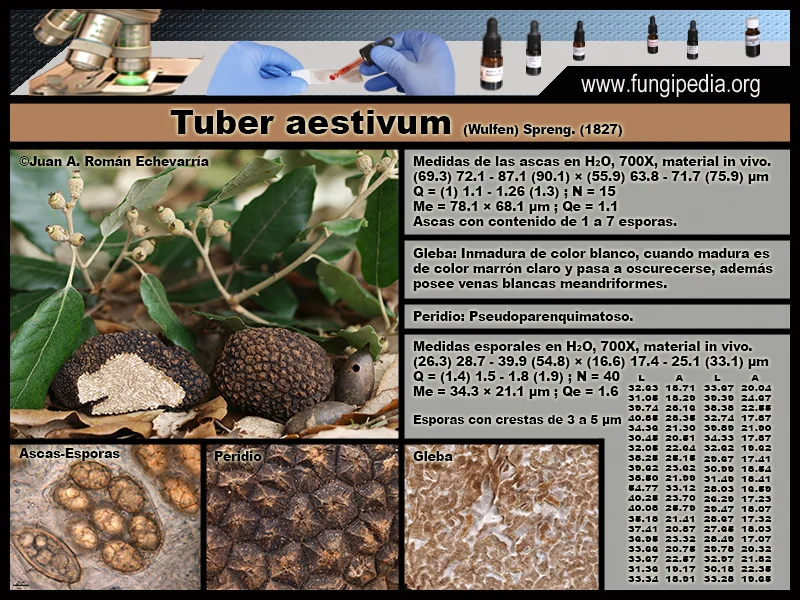
Fruiting body highly variable in size; adult specimens can range from merely a couple of centimeters in diameter to others reaching 7 to 8 cm. Initially globose, it gradually adopts somewhat irregular and uneven shapes as it matures, occasionally becoming nearly amorphous.
Peridium or external surface is generally black, sometimes very dark brown, and is entirely covered by warts with a pyramidal base that typically taper to an acute apex. These warts are notably widely spaced apart and can reach heights exceeding 5 mm in some cases.
Gleba compact and non-powdery, whitish when young, later turning brownish. It is thoroughly veined with white channels, imparting a distinct labyrinthine appearance.
Flesh firm and compact, yet tender, with a characteristic, strongly aromatic odor and a highly pleasant flavor.
Habitat:
It is a hypogeous species that fruits buried at shallow depths beneath a wide variety of trees, including both broadleaf species and pines. It is primarily foraged in the wild, although orchards of holm oak mycorrhizally inoculated with this fungus also exist. Its fruiting season occurs during summer, though depending on prevailing climatic conditions, it may begin as early as May.
Observations:
This summer truffle possesses a notable aroma and pleasant flavor, but it does not command as high a market price as the winter truffle, Tuber melanosporum, whose market value is four times that of the present species; consequently, cultivators generally prefer the winter variety. Macroscopically, they can be distinguished, aside from their fruiting periods, by the black gleba of Tuber melanosporum and by its peridial scales, which lack a pyramidal base. The white truffle of Piedmont, Tuber magnatum, commands the most exorbitant prices. These specimens were photographed courtesy of Ángel Sáenz Fernández, a renowned truffle cultivator from La Rioja.
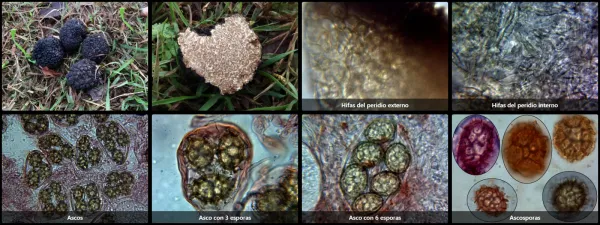
Microscopy of Tuber aestivum