
Tubaria cistophila
Taxonomy
Main synonym
Common names
Tubaria de las jaras
Geographic references:
Interactive map with data from GBIF.


Morphological Features:
Pileus of small dimensions, the diameter of collected specimens ranges between 5 and 12 mm, rarely can somewhat larger specimens be found. Clearly convex in young specimens, flattening with development, possibly developing a slight central depression in older ones. Cuticle quite pruinose but scarcely flocculose, subvelutinate, tending to lose the veil over time; color variable depending on hydration, within ochre or brown tones, honey-toned when young and ocraceous-brown upon drying, generally lighter towards the margin. Margin fairly regular, which may be slightly crenulate.
Lamellae subdecurrent in young specimens and subsequently clearly decurrent, fairly distant from each other and with numerous lamellulae; pale in color initially, then honey-ochre, and finally ocraceous-brown, color development similar to other Tubaria species, straight to arcuate, with an entire and concolorous edge.
Stipe cylindrical, length typically ranges between 2 and 3 cm by merely a couple of mm in thickness, fistulose like other congeners, brown in color somewhat darker than the pileus, sometimes with a cortinate zone and more often without it, quite pruinose, especially at the apex, although it tends to lose the pruina over time until becoming smooth.
Flesh scant, fragile and not very firm, ochre in color, more fibrous in the stipe; it has a mild fungal odor and an analogous taste.
Habitat:
This is a saprotrophic species exclusively associated with rockroses (Cistus sp.), making it easier to locate in Mediterranean climates where these plants are abundant; however, this represents the first record for the Basque Country. Found under Cistus albidus in Fontecha (Álava), within a calcareous holm oak woodland but in an area devoid of tree cover, with only rockroses and numerous bryophytes present. A rare species requiring protection, along with its ecosystem, especially in northern regions such as this case, where it is very scarce. It emerged in small groups of just a few specimens and was located in the month of December.
Observations:
A rare species requiring protection, characterized by its small size, its more or less decurrent and distant lamellae, and within the genus by its exclusive habitat. On that same day, we located other Tubaria species with which it could be confused: Tubaria hiemalis, which is much larger and has floccose remnants on the pileal margin; Tubaria conspersa, which is also more velutinate and somewhat larger, with dull tones on the pileus. It may also be confused with other species found in the vicinity, such as various Conocybe spp., Galerina spp., or Flammulaster sp..
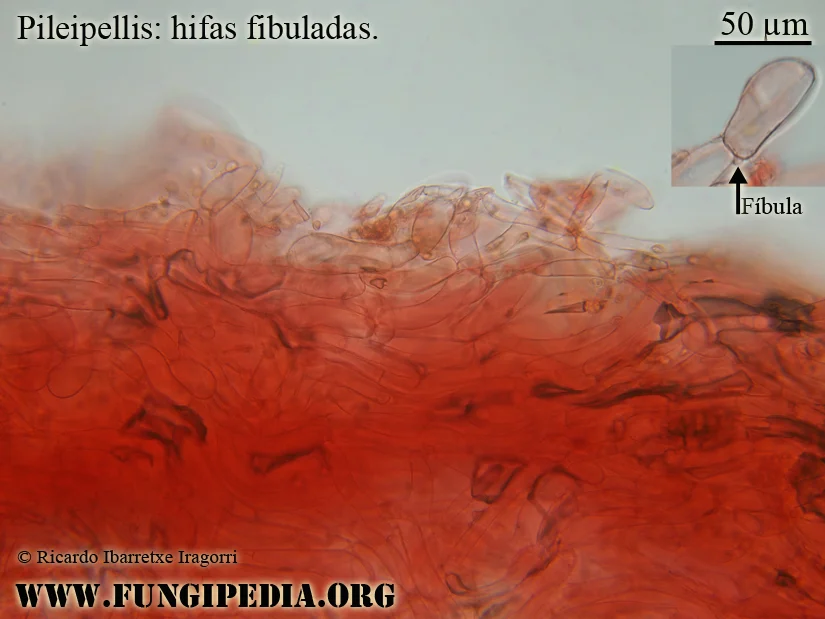
Microscopy of Tubaria cistophila