

Tricholomopsis rutilans
Taxonomy
Main synonym
Common names
Tricoloma rutilante.
Geographic references:
Interactive map with data from GBIF.




Morphological Features:
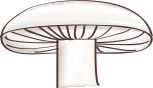
Pileus up to 15 cm in diameter, convex for much of its development, later becoming more flattened, strikingly colored and apparently red due to being entirely covered with spots of this color, although the background is more yellow. Margin somewhat incurved in young specimens and later smooth.
Lamellae bright yellow, adnate to slightly sinuate, and generally quite crowded.
Stipe central and cylindrical, usually curved at the base, appears somewhat more yellow than the pileus because the red spotting is not as close-set as on the latter. Fibrous in consistency, it typically exhibits a completely yellow zone adjacent to the lamellae.
Flesh firm and yellow, without a distinctive odor, and slightly bitter in taste when raw.
Habitat:
Grows always attached to conifer stumps, sometimes in caespitose clusters. It is a saprotrophic fungus that appears practically year-round.
Observations:
Not a species of culinary interest due to the slight bitterness of its flesh, but it is harmless. There are other Tricholomopsis species with which it could be confused: Tricholomopsis decora, with an entirely yellow pileus; Tricholomopsis ornata, with a squamulose pileus streaked by brownish-violet fibrils; and Tricholomopsis flammula, which barely reaches 2 cm.