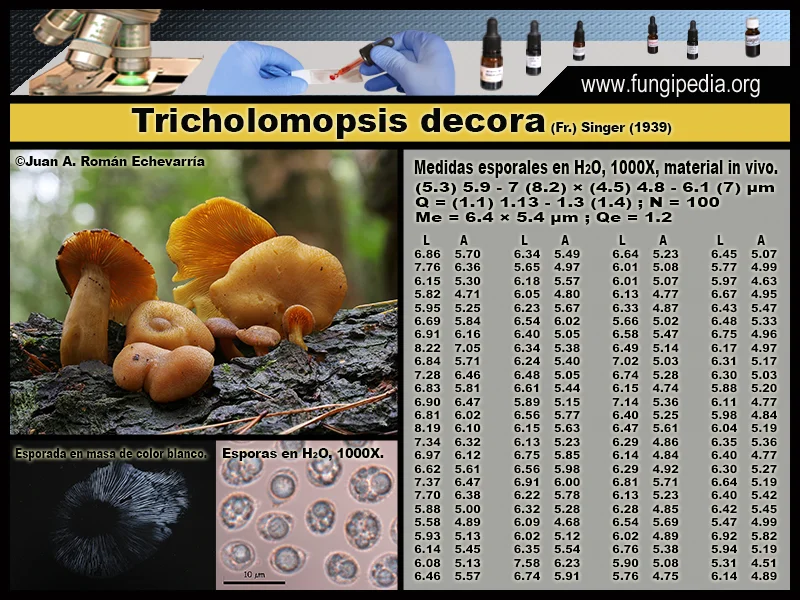

Tricholomopsis decora
Taxonomy
Main synonym
Common names
Tricholoma decorado.
Geographic references:
Interactive map with data from GBIF.
Morphological Features:
Pileus of variable diameter; some mature specimens do not exceed 3 cm, while others surpass 10 cm. Initially convex in early developmental stages, it gradually flattens to become broadly expanded, with mature specimens frequently exhibiting a slight central depression. The cuticle is separable from the flesh, generally dry in appearance, slightly glossy when wet but not viscid. The background color is a more or less vivid yellow, overlaid with small brownish scales that are more prominent and dense centrally, fading towards the margin where they typically become concolorous with the surface. The margin is involute in young specimens, opening to become straight and quite thin, sometimes recurving in age.
Lamellae generally adnate, sometimes slightly emarginate, very crowded with abundant lamellulae. They are a fairly vivid yellow, arranged somewhat irregularly, with an entire edge that is concolorous or frequently a less vivid shade of yellow.
Stipe central to slightly eccentric, solid when young and becoming hollow at maturity. Generally longer than the pileus diameter, more or less cylindrical, and typically curved. It shares a similar yellow coloration to the pileus, somewhat fibrillose, but lacking the pronounced squamulose texture of the cap. The base, where it attaches to the mycelium, is often slightly whitish.
Flesh thin and fibrous in consistency, invariable when cut. Yellowish in color, more pronounced in the pileus and duller in the stipe; it may be ochraceous at the base. It possesses a mild fungal odor and a sweet taste that becomes slightly bitter upon prolonged chewing.
Habitat:
This is a saprobic species that develops on dead wood, contributing to its decomposition. It was once very rare in our region, but in recent years it has appeared with greater frequency and proliferated somewhat; we now encounter it reliably every year. It is generally observed on dead coniferous wood; we have found it on pines (Pinus ssp.), Lawson cypress (Chamaecyparis lawsoniana), Norway spruce (Picea abies), or Japanese larch (Larix kaempferi). It typically fruits in gregarious to fasciculate clusters, rarely solitary, with autumn being its preferred season of emergence.
Observations:
This species is inedible due to its scant flesh, fibrous texture, and slightly bitter taste. It shares many similarities with its close relative, Tricholomopsis rutilans, from which it can be distinguished macroscopically by the latter's conspicuous reddish scales on both the pileus and stipe, and microscopically because the spores of T. rutilans are smaller and more globose, with a lower Q value. Tricholomopsis ornata is also very similar, but possesses cylindrical pleurocystidia that are narrower than those of the present species. Other similar species within the genus exist, generally American taxa such as Tricholomopsis sulfureoides, which has yellowish scales, or Tricholomopsis bella, which is practically devoid of squamules.
Microscopy of Tricholomopsis decora