
Tricholoma sejunctum
Taxonomy
Main synonym
Common names
Tricoloma amarillo, ziza berde-beltz.
Geographic references:
Interactive map with data from GBIF.


Morphological Features:
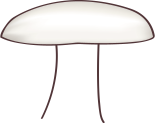
Pileus with a diameter in adult specimens ranging from 5 to 10 cm, convex for much of its development, then plano-convex and finally flattened. Its surface is glabrous and dry, becoming glossy when wet, with somewhat variable coloration; the most typical specimens of the species have a predominantly yellowish-green background color, darker at the center and more olivaceous toward the margin, although lemon-yellow individuals with olivaceous tinges can also be found. The separable cuticle is covered with brown fibrils that may turn dark brown to blackish upon drying. The margin is fairly regular and slightly incurved when young.
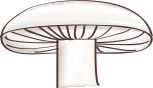
Lamellae sinuate and adnate in many specimens, relatively distant, whitish with yellowish tinges, thick, and unequal in length. The lamellar edge is uneven and often serrate.
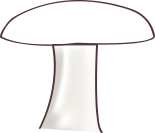
Stipe proportionate to the pileus, white with frequent traces of olive-green, solid and cylindrical except at the base where it usually tapers, and in some specimens comes to a point. It is smooth or slightly fibrillose.
Flesh thick, white, compact, and fibrous; it has a not unpleasant farinaceous odor in young specimens that becomes rancid and more unpleasant over time. The taste is markedly bitter.
Habitat:
A common and cosmopolitan species in our region, it fruits both on the needle litter of various pines and under diverse broadleaf trees, sometimes becoming abundant. Its preferred fruiting season is autumn, and it rarely appears singly.
Observations:
It is a common and well-known species; furthermore, it is bitter and therefore inedible. Due to its coloration, it may bear some resemblance to Amanita phalloides, which possesses an annulus and volva. The edible species with which it shares the greatest similarity is undoubtedly Tricholoma portentosum, a commonly collected species that lacks a yellowish-green pileus and instead has a much darker cap. Other Tricholoma species with yellowish tones and white lamellae exist, such as Tricholoma joachimii, none of which are edible.