
Tricholoma fulvum
Taxonomy
Main synonym
Common names
Tricoloma pardo amarillo, ziza hori marroi.
Geographic references:
Interactive map with data from GBIF.
Morphological Features:
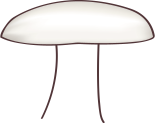
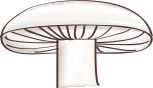
Pileus reaching up to 10 cm in diameter at most in mature specimens, distinctly convex for much of its development, later flattened or somewhat gibbous, inconsistently bluntly umbo-nate. The surface is slightly viscid when wet or otherwise subdry, moderately fibrillose, essentially brown with reddish tints that usually predominate in the central area, or yellowish due to drying and towards the margin. This margin is incurved and striate in many specimens.
Lamellae generally adnexed, sometimes uncinated, very crowded, yellow when young, staining ochre and reddish with age, and also staining upon handling.
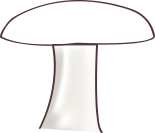
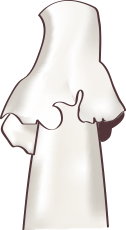
Stipe commonly elongated, cylindrical or more typically irregular, tending to be curved, usually thickening in the lower portion before tapering towards the base; in some specimens it may be clavate. Surface with a yellowish background covered in brown fibrils that become more conspicuous with age, possibly except at the apex.
Flesh relatively thick, whitish in color, somewhat more yellowish near the surface, fibrous. It has a faint farinaceous odor and a bitter taste.
Habitat:
This is a species that forms mycorrhizae exclusively with birches (Betula sp.), although a currently synonymized variety may occur under conifers. It fruits solitarily or in small groups, primarily during autumn, but may occasionally appear at other times of the year. The specificity of its habitat renders it a relatively uncommon species.
Observations:
It is a species that can be identified with relative ease given its characteristics; the presence of yellow lamellae, particularly when young, is a relevant and distinctive character, as is the striate margin found in numerous specimens. Tricholoma nictitans is currently synonymized with this species; its lamellae are merely yellowish or sometimes cream-colored, and it grows under conifers. There are many species in the genus Tricholoma with brown or ochre tones, but none of them possess lamellae of this color.