

Tricholoma equestre
Taxonomy
Main synonym
Common names
Seta de los caballeros, zaldun-ziza orrihori, verderol.
Geographic references:
Interactive map with data from GBIF.




Morphological Features:
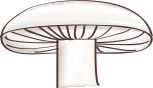
Pileus that can exceed 10 cm in diameter, convex in shape and later flattened, somewhat depressed when old. The ground color is yellow, but it is covered with brownish or olivaceous fibrils distributed irregularly, though denser towards the center and nearly absent at the margin. The cuticle is separable and dry.
Lamellae sinuate and crowded, bright yellow in color, with the edge somewhat serrate but also yellow.
Stipe also yellow in color with some brownish tones appearing as fibrils or a fringe, though yellow predominates. Cylindrical and highly variable in thickness depending on the habitat.
Flesh a paler yellow than the exterior of the fruitbody, compact, with a mild fungal odor and an agreeable taste.
Habitat:
A species exclusive to conifers, particularly pine forests, appearing throughout autumn.
Observations:
There is fierce controversy surrounding its potential toxicity, and it is our duty not to recommend its consumption, as it appears to cause rhabdomyolysis through accumulation, a severe pathology affecting the muscles that can prove fatal. It is currently synonymized with Tricholoma auratum, which, however, is umbonate. It also resembles many yellow-toned Tricholoma species, such as fucatum, viridifucatum, viridilutescens, etc., all of which have whitish lamellae. It fruits abundantly in sandy pine forests dominated by Pinus pinaster and Pinus pinea.