
Trichoglossum hirsutum
Taxonomy
Main synonym
Common names
Lengua de tierra hirsuta.
Geographic references:
Interactive map with data from GBIF.

Morphological Features:
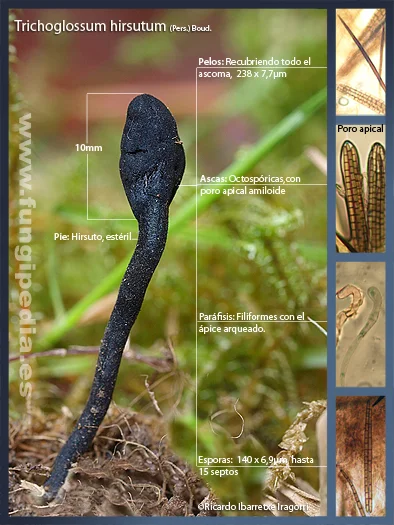
Fruiting body elongated, slender, and stipitate, reaching a height not exceeding 5 cm. It comprises two perfectly differentiated parts; the upper portion features an enlargement resembling a head, tongue- or spatula-shaped, with variable width, and is entirely black in color. This head constitutes the fertile portion of the fruiting body and is furnished with bristly hairs visible under a hand lens, which emerge from the surface bearing the hymenium of this species, and consequently its asci. Typically, this head is furrowed, appearing dry or glossy when wet, but never viscid.
Stipe long and perfectly differentiated from the head, equally black in color, and like the latter, covered with hairs over its entire surface; it is sterile and solid.
Flesh insignificant, as is its odor or taste.
Habitat:
It is perhaps the most frequent species in our region among the so-called earth tongues, typically growing in groups. It occurs among grass in meadows and is commonly found during December and January.
Observations:
This species is identified using a hand lens, which allows observation of the hairs covering it entirely. However, a form with tetrasporic asci exists, separated as an individual taxon under the name Trichoglossum tetrasporum. It also resembles Geoglossum fallax, which lacks surface hairs.
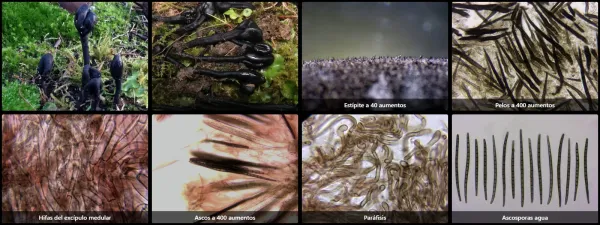
Microscopy of Trichoglossum hirsutum