
Trichoderma pulvinatum
Taxonomy
Main synonym
Common names
Not available
Geographic references:
Interactive map with data from GBIF.
Morphological Features:
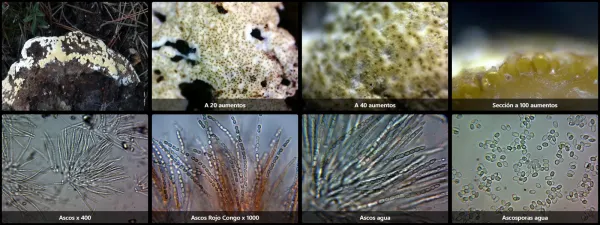
Description This is a fungus that, as occurs with many other Ascomycetes, appears in nature in two perfectly differentiated forms. The most commonly encountered form is the so-called imperfect state, represented by individual cushion-shaped ascocarps of a more or less vivid yellow color with a whitish margin. These ascocarps are pruinose and pulvinate, typically not exceeding 2 cm in width, although they tend to interconnect, sometimes forming true crusts. Over time, as they mature, they gradually adopt a duller yellowish-ochre color. The other form occurs as crusts on the substrate ranging from ash-gray to dark brown.
Hymenium composed of a perithecium that terminates in so-called ostioles, small pores through which mature spores are released to the exterior. Immature asci are eight-spored, but upon maturation, a process known as budding occurs, whereby each spore divides into two, resulting in mature asci containing 16 spores each.
Stipe absent; attaches directly to the substrate.
Habitat:
It is precisely the habitat that macroscopically differentiates this species from others in its genus, as it fruits on the fruit bodies of the so-called birch tinder fungus, Fomitopsis betulina, and Fomitopsis pinicola, when they are already aged. Therefore, the ideal time to locate it is when these bracket fungi are past their prime, which may occur in late autumn, although its appearance is also possible at other times of the year. It occasionally parasitizes Laetiporus sulphureus as well. It is an uncommon species.
Observations:
This is a parasitic fungus of Fomitopsis betulina and Fomitopsis pinicola, which distinguishes it from other species in its genus. Within the genus Hypocrea, there are species that fruit as crusts, such as Trichoderma citrinum, which forms yellowish, speckled crusts and parasitizes wood debris and leaves. Trichoderma aureoviride has the same shape and color as the species described here, but it grows on broadleaf tree wood and typically exhibits green speckles.