Hemitrichia decipiens
Taxonomy
Main synonym
Common names
Not available
Geographic references:
Interactive map with data from GBIF.





Morphological Features:
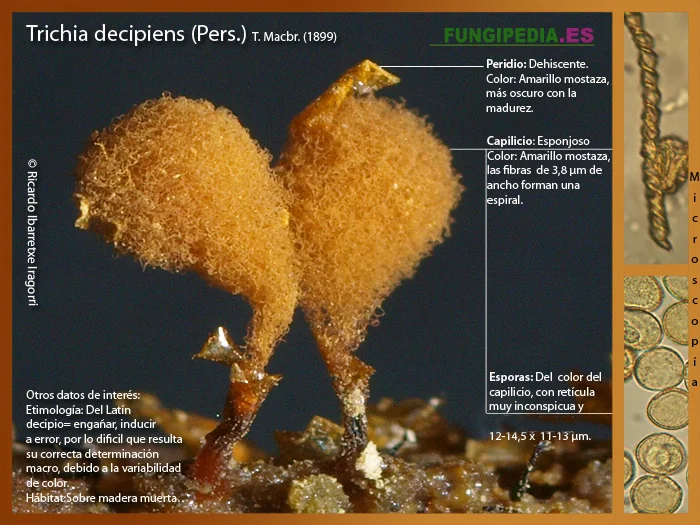
Sporophore growing individually but in gregarious clusters, with a size not exceeding 3 to 4 mm in height. It exhibits considerable variability in shape and color throughout its development: initially reddish with a small white stipe, it subsequently pales to orange-ochre tones, then becomes ochre while the stipe darkens and reddens, finally forming a yellowish-ochre capillitium. Its shape is globose or pyriform in the early stages; later, upon sporulation, it assumes the form of a cup overflowing with fibers. The capillitium consists of elongated, spirally twisted sterile fibers lacking longitudinal striations, which aid in the dispersal of spores located among them. The peridium is dehiscent and shiny, with small folds toward the stipe; upon maturation, it ruptures to reveal the capillitium.
Spores rounded to slightly oblong, approximately 11 to 14 μm in size, surrounded by a radially arranged reticulate pattern, with an occasionally irregular margin.
Stipe constitutes approximately 50% of the total height; initially white, it later becomes reddish-ochre, mucoid, and filamentous.
Habitat:
A frequent species that can be located practically year-round. It fruits on all types of dead wood, tree bark, or branches. The photographed specimens were found on dead beech wood.
Observations:
It is the most common species in the Trichia group, characterized by its color variability and its yellowish-ochre capillitium with spirally arranged fibers lacking longitudinal striations. It can be confused with numerous species, to the extent that without the invaluable aid of a microscope, its identification would be problematic. In fact, it may be mistaken for other species within the same genus, such as Trichia pesimilis, which differs only by the reticulate patterns adorning its spores, and with many Arcyria species, such as Arcyria pomiformis.
Microscopy of Hemitrichia decipiens