
Tremellodendropsis tuberosa
Taxonomy
Main synonym
Common names
Not available
Geographic references:
Interactive map with data from GBIF.

Morphological Features:
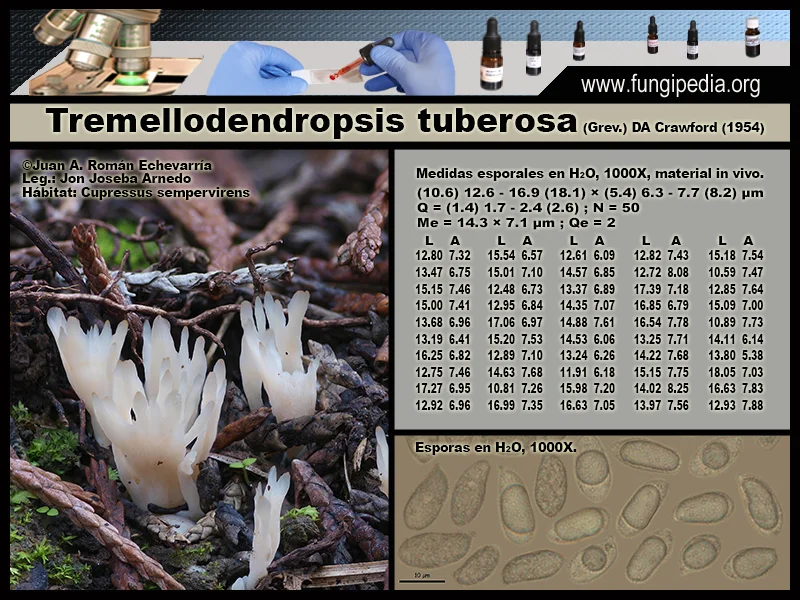
Fruiting body of rather small size, with a height in our collection that did not exceed 3 cm, although references indicate it can occasionally reach 6 cm, and a maximum width of 1 to 3 cm. It has a branched coralloid shape, with an overall appearance strongly reminiscent of species in the genus Clavaria, although certain features also recall the genus Telephora. Branches emerge from a common stipe-like base, typically 2 to 3 per branch; it is not densely branched and generally forms V-shapes, though not invariably. The branches terminate in an apex that is initially somewhat pointed but usually becomes quite rounded and flattened upon maturity. The coloration is pale, whitish to cream, darkening from the apex towards brownish or greyish tones.
Hymenium developed exogenously on the branches of the fruiting body; it is noteworthy that both the stipe and the apical region are sterile, while the remainder is fertile. Its color varies as indicated in the previous section; the surface is slightly rugose. It yields a white spore print, with finely granulate spores and typical basidia compressed longitudinally to appear septate, which is difficult to discern under the microscope (see microscopic features).
Stipe more or less distinct in the lower region, defined here as the portion extending from the base to the onset of branching; it is pale-colored and rather cylindrical, with variable but generally short length. When uprooted, remnants of white mycelium are visible at its base.
Flesh with a consistency markedly different from that of Clavaria species, which are typically fragile; this fungus exhibits greater tenacity, does not break as easily, and is more fibrous. It is insipid but possesses a distinct, rather acidulous odor. The flesh does not change color upon cutting or handling.
Habitat:
Tremellodendropsis tuberosa is a species that can be classified as uncommon, or at least poorly documented in our region. It typically fruits in groups wherever it occurs; isolated specimens are rarely observed. It does not exhibit a predilection for any specific forest type, having been found under both broadleaf and coniferous trees. The collection serving as the basis for this record was kindly provided by Joseba Arnedo and corresponds to the locality of Amurrio in Álava, where it fruited beneath cypresses (Cupressus sempervirens). This is a late-fruiting species, typically observed in late autumn, as well as during winter or early spring.
Observations:
We are dealing with a species that appears intermediate between Clavaria and Telephora; while visually it is closer to the former, it can be distinguished by observing the tough, fibrous consistency of its flesh, which differs markedly from other genera with similar appearances. We have no records of other species of this genus occurring in our territory; in fact, we believe it is the only one documented at the European level, although such matters are always subject to change in a constantly evolving science. Microscopically, it is characterized by longitudinally septate basidia, a monomitic hyphal system, and finely granulate spores with a somewhat oblique apicula arrangement. At first glance, it could be confused with pale-colored Ramariopsis species, such as Ramariopsis Kunzei, although the latter has more fragile flesh, as previously mentioned, and is quite different microscopically.
Microscopy of Tremellodendropsis tuberosa