
Trametes versicolor
Taxonomy
Main synonym
Common names
Yesquero multicolor, larruki koloreanitz.
Geographic references:
Interactive map with data from GBIF.


Morphological Features:
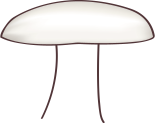
Basidiocarp annual, sessile, non-stipitate or pseudostipitate, but generally effused-reflexed, not resupinate, reaching up to 10 cm in width, with a radius of approximately 5 cm, and a thickness of merely a few millimeters. It is semicircular to fan-shaped, arising from the substrate, and invariably grows in more or less numerous, imbricate clusters. The surface exhibits multiple colors arranged in concentric zones, ranging from pale, nearly white tones to almost black, interspersed with brown or gray shades of varying hues. The surface is villous in young specimens, becoming glabrous with age, while the margin is irregularly undulate.
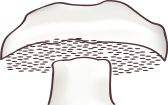
Hymenium composed of small pores, up to 5 per mm, generally rounded, sometimes slightly angular, white in color, turning cream with age.
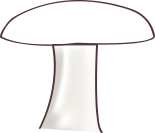
Stipe Very short and embedded in the substrate or absent, hence we consider this species sessile.
Flesh very hard, white, coriaceous, and fibrous. In the zone of attachment to the substrate it can reach a thickness of about 5 mm, but at the margin it barely reaches 2 mm. Without odor or flavor worthy of mention.
Habitat:
This species fruits on the wood of broadleaf trees, conifers, and even some fruit trees, causing a white rot in the host tree. It is a very frequent and widespread fungus that can appear at any time of year provided environmental conditions are suitable.
Observations:
This common species inhabiting our forests has important medicinal uses, some of which remain to be investigated. Its efficacy in treating various types of cancer caused by human papillomavirus, such as breast or uterine cancer, has been demonstrated; furthermore, it helps minimize the effects of chemotherapy in humans. The variability in its coloration has led to the description of several varieties; it is common in our region to find specimens with a predominance of dark zones, a variety that has been referred to as nigrescens or nigricans, a distinction to which we attach little taxonomic significance. No other Trametes species combines these characteristics—concentric zones of varying colors, a villous pileus, etc.—and therefore we consider it unmistakable.