
Trametes hirsuta
Taxonomy
Main synonym
Common names
Yesquero blanco peludo, larruki ilelatz, bolet de soca blanc.
Geographic references:
Interactive map with data from GBIF.


Morphological Features:
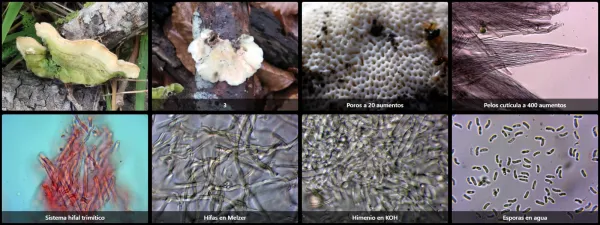
Fruiting body annual, not perennial, reaching up to 10 cm in width, with a projection roughly half that size, and a thickness of approximately 1 cm at its widest point. It is semicircular to fan-shaped, white when young, gradually developing grey tones of varying intensity with age. The surface may exhibit concentric zones of various shades, but is not distinctly zoned; it is prominently covered throughout by erect, white to silvery hairs. The margin or growth zone is yellowish-white when young, eventually turning ochre.
Hymenium pore-bearing, with pores measuring 3 to 4 per mm; whitish when young, later becoming creamy and occasionally tinged greyish, turning ochraceous in age.
Stipe absent; this is a sessile species.
Flesh softer than it appears, especially when young, gradually hardening in layers until becoming corky in texture. Initially white, it darkens to grey with age; the odour is mild and pleasant, and the taste is indistinct.
Habitat:
A saprotrophic fungus that decomposes the dead wood upon which it fruits. It can be found throughout the year causing white rot on branches or stumps of broad-leaved trees, with a slight preference for beech. This is a fairly common species.
Observations:
It is characterized by its hairy surface, which distinguishes it from other congeners. Trametes versicolor has thinner flesh and a distinctly concentrically zoned surface; Trametes pubescens lacks both zones and hairs, being merely tomentose and white, otherwise also resembling this species. We have observed that inexperienced amateurs often confuse it with Stereum hirsutum due to the presence of hairs, but Stereum species possess a smooth hymenium and virtually no flesh.