

Trametes gibbosa
Taxonomy
Main synonym
Common names
Yesquero blanco, ardagai konkordun, bolet de soca blanc.
Geographic references:
Interactive map with data from GBIF.




Morphological Features:
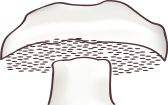
Basidiocarp large for the genus, easily exceeding 10 cm in width and occasionally approaching 20 cm, with an excurrent margin over 5 cm and considerable thickness. Semicircular in shape, more or less flattened, or more commonly gibbous. Surface white and tomentose when young, becoming greyish and glabrous with age, very weakly zoned. The margin, concolorous with the rest of the surface, is thin and fairly regular.
Hymenium composed of radially arranged pores, angular when young, elongating with age to eventually form labyrinthine networks in older specimens; whitish or cream-colored, measuring approximately 1 mm per pore, up to 2 pores per mm at most.
Stipe absent; this species is sessile.
Flesh of considerable thickness at the point of attachment to the substrate, up to 4 cm, while thin at the margin, only a few millimeters thick. White in color, though occasionally showing areas of different coloration; texture notably corky. Odor pleasant; taste mild.
Habitat:
Occurs on hardwood throughout almost the entire year, exhibiting a saprotrophic lifestyle, i.e., growing on already dead wood. It should be considered a common species.
Observations:
Trametes species are wood-decay fungi that cause white rot. It can be distinguished from other congeners by its thick flesh at the point of attachment to the substrate, its more or less gibbous shape, the absence of hairs or light concentric zones, as well as its margin being concolorous with the rest of the surface. Trametes hirsuta has very conspicuous hairs on its surface; Trametes pubescens is more similar, but with thinner flesh.