
Tolypocladium ophioglossoides
Taxonomy
Main synonym
Common names
Not available
Geographic references:
Interactive map with data from GBIF.
Morphological Features:
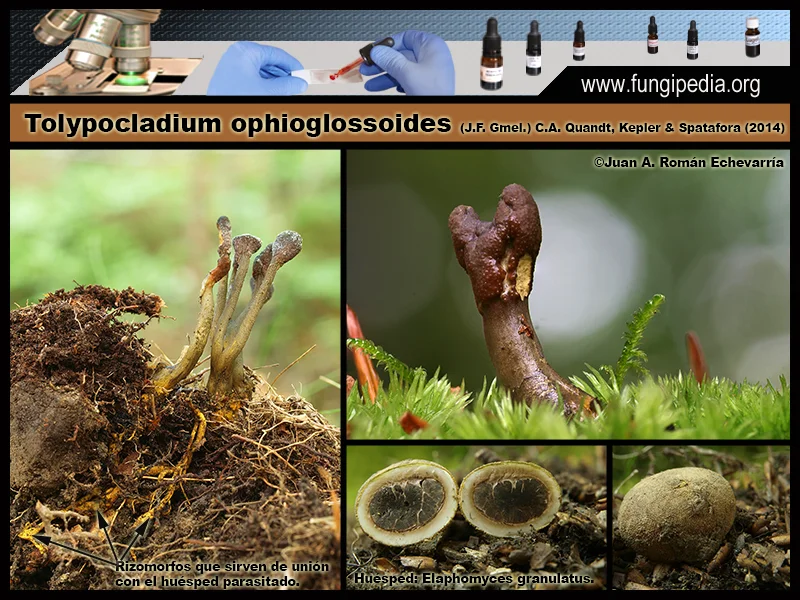
Carpophore composed of two perfectly differentiated parts; the upper part, termed the stroma, is match-head shaped and finely punctate with ostioles, which are pore-like openings through which spores emerge from the perithecia housing the asci. It is reddish-brown in its initial stage, later turning distinctly black. It typically bears a central cleft, resembling some Geoglossum species.
Stipe constituting the lower portion of the carpophore and distinguishable from the stroma. It is elongated, with coloration ranging from olive-green when young to black. Slender and rounded, it bears bright yellow, rootlet-like rhizomorphs at the base that contrast sharply with the remainder of the stipe. These structures serve as attachment points to the parasitized host.
Flesh yellow in color with an elastic consistency, readily apparent upon longitudinal sectioning. Nothing noteworthy regarding odor or taste.
Habitat:
An interesting observation: some authors place it among firs, while others locate it under oaks; we must report that we have found them under beeches. We believe the specific habitat is not particularly relevant. Specimens have been collected from late summer into early autumn.
Observations:
A curious parasitic species, like the remainder of its genus, which parasitizes Elaphomyces granulatus, potentially inducing multiple ascostromata on the same host. We have noted, though unsure of its significance, that it attacks individuals already decayed or in an advanced state of decomposition, whereas Tolypocladium capitatum targets living hosts. Both species have been located at exactly the same site. It may be confused with species of the genus Geoglossum, which lack perithecia.
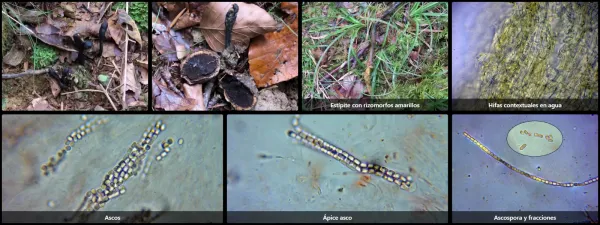
Microscopy of Tolypocladium ophioglossoides