
Tolypocladium capitatum
Taxonomy
Main synonym
Common names
Boilur-mazo.
Geographic references:
Interactive map with data from GBIF.

Morphological Features:
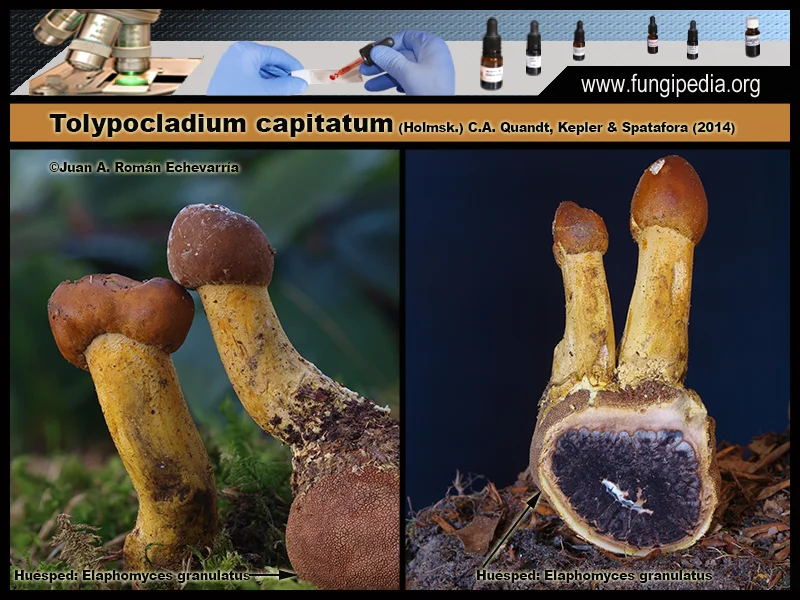
Fruiting body of small size, composed of two well-differentiated parts: the upper portion or stroma and the stipe. The entire structure resembles a matchstick with a thick head. The stroma is yellowish-brown, occasionally exhibiting olive tones, but gradually darkens to more blackish hues over time. It constitutes the fertile portion of the fruiting body, bearing small openings termed ostioles, which represent the apices of the perithecia containing the asci that house the spores. Upon maturation, spores are discharged externally through the ostioles, coating the head with a powdery deposit lighter than its typical coloration.
Stipe which can reach considerable length (up to 8 cm). It emerges from the parasitized individual and extends outward, with a portion remaining embedded within the host Elaphomyces. It is yellowish in color and may exhibit a zigzag pattern, though it is sometimes smooth.
Flesh is indistinct, with an insignificant odor and taste.
Habitat:
This species lives in association with its host, and therefore its habitat depends on that of the host. In this specific case, it was documented in a Fagus silvatica (beech) forest in September, parasitizing Elaphomyces granulatus. A rare species.
Observations:
This conspicuous species is distinguished by its thick head from Tolypocladium ophioglossoides, which is additionally darker in color but occurs in the same habitat. This parasite of Elaphomyces specimens has a very closely related counterpart, and their differentiation is indeed problematic as it relies solely on microscopic characters; this refers to Elaphocordyceps canadensis, whose spores are broader and possess thicker walls.
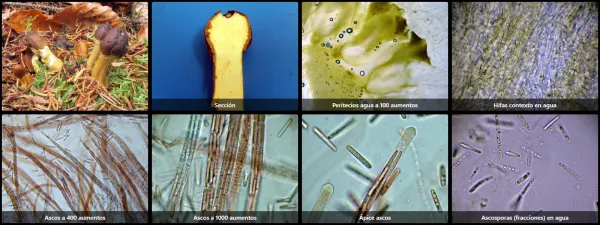
Microscopy of Tolypocladium capitatum