
Tirmania nivea
Taxonomy
Main synonym
Common names
Trufa del desierto, maná, zubaidi, fagaa, terfez
Geographic references:
Interactive map with data from GBIF.





Morphological Features:
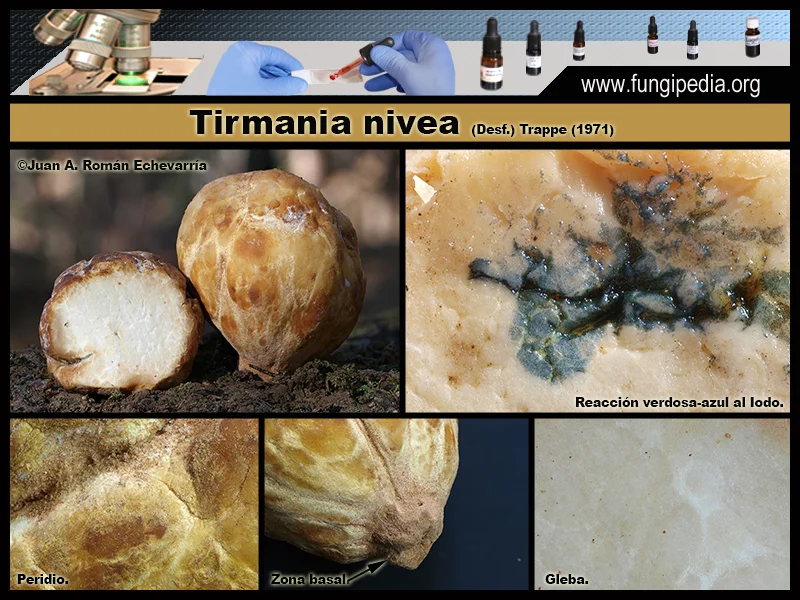
Fruiting body which may adopt somewhat variable shapes, generally globose or subglobose, with the tuberous form typical of hypogeous species, although it often assumes a fig-like shape, with a sort of pseudostipe attaching it to the substrate. It is of quite substantial size, potentially exceeding 10 cm in diameter; its color upon extraction is practically white or very pale cream, but soon turns to more distinctly creamy or light ochre tones upon oxidation, even slightly yellowish, becoming brownish upon aging.
Peridium thin, smooth and glabrous, not at all tomentose, usually appearing irregularly furrowed, and often bearing protuberances; upon scratching, the gleba can be accessed with relative ease.
Gleba very fleshy, in the early developmental stages very pale in color with completely white veins; over time it adopts pinkish tones and finally ochre in its final stage, while the venation consistently maintains a lighter tone throughout.
Flesh firm, with a pleasant texture when bitten, possessing a characteristic mild sweetish odor; its taste is also mild and delicate, very agreeable. With iodine solutions it adopts a greenish tone that turns blue in a short time.
Habitat:
This is an interesting aspect of this species, as it occurs in somewhat inhospitable locations subjected to high temperatures and significant water stress, even desert areas. It fruits forming ectomycorrhizae with host plants, generally certain Cistaceae, such as Helianthemum lippii or Helianthemum salicifolium, in soils with a basic pH, above 7. They do not usually appear in large groups or rings, but several specimens can be found emerging near the same plant. It is a species that appears in winter months, following the much-needed rains in regions where precipitation is scarce. The studied specimens originated from northern Algeria; it occurs throughout North Africa and has also been recorded on the Iberian Peninsula in Almería.
Observations:
Under the common name or designation "desert truffle", several species can be found depending on the region, with the one presented here being the most characteristic. It is a species we have had the opportunity to taste and which we consider a choice edible, superior to most species of the genus Terfezia. It is characterized macroscopically by its white color upon collection, its agreeable odor and taste, the narrowing it usually exhibits towards the base, and its pale gleba with white veins; microscopically, by the amyloid nature of its asci. Terfezia claveryi may share the habitat, although it usually fruits with Tuberaria sp.; it bears some resemblance but is darker and equally a choice edible.
Microscopy of Tirmania nivea