
Terfezia claveryi
Taxonomy
Main synonym
Common names
Turma, trufa del desierto, criada, criadilla.
Geographic references:
Interactive map with data from GBIF.



Morphological Features:
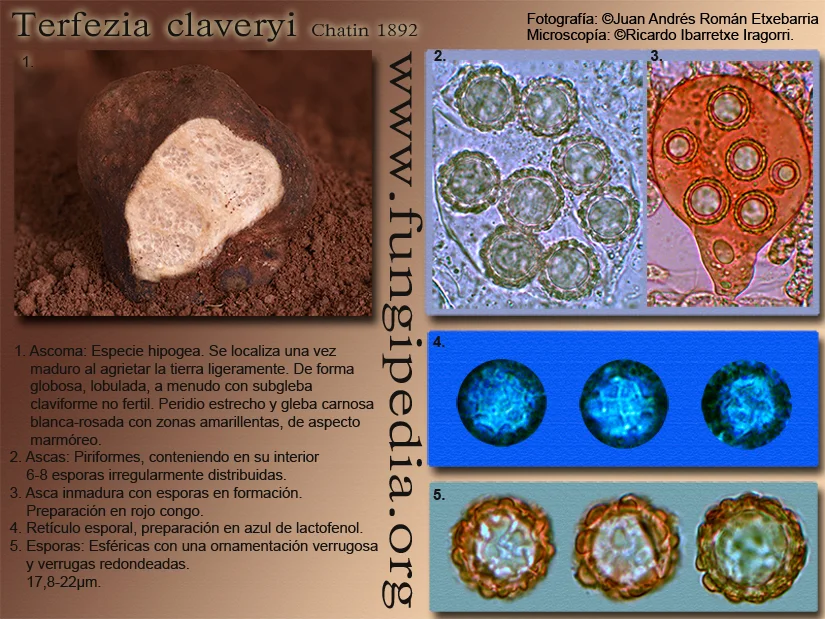
Fruiting body that can reach a considerable size; specimens with a diameter approaching 15 cm and a weight close to 500 g have been collected, but it is more common to find specimens with a diameter ranging between 5 and 10 cm. Its shape is quite irregular; it may develop protrusions or become lobed. It often has a turbinate (top-shaped) form, presenting at the base a non-fertile zone resembling a conical appendix. Its color is variable, predominantly brown, with different shades depending on the specimen's maturation stage: ranging from salmon or pinkish tones to reddish hues, and tending to darken in its final stage.
Peridium of intermediate thickness; in cross-section, the peridium measures 1 to 2 mm thick with pinkish or whitish tones, sometimes cinnamon-colored. Externally, it is smooth but may crack or darken as the ascocarp ages.
Gleba compact and hard with a fleshy appearance, composed of two intermingled zones, one fertile and the other sterile, giving it a veined appearance. The color of both zones varies with maturation: initially, the sterile part is whitish and the fertile part pinkish. Over time, they acquire salmon tones and eventually reddish-brown to dark brown/blackish hues. Upon full maturation, the fertile portion predominates, while the sterile tissue reduces to nearly imperceptible veins.
Flesh compact and solid, with a pleasant but faint odor and an equally pleasant nutty flavor.
Habitat:
This species fruits in clayey or sandy soils, with a preference for alkaline pH, and is inextricably linked to plants of the genus Helianthemum, with which it forms mycorrhizae and which are popularly referred to as the "mother plant". Geographically, on the Iberian Peninsula, it occurs in eastern Andalusia and generally in the southeastern peninsula. However, the first time we encountered it was from Morocco, where it is well-known, as it is throughout North Africa and the Middle East. It emerges in groups, protruding very little from the soil due to its semi-hypogeous nature, and its fruiting season on the peninsula is spring. We thank our friend and collaborator Paco Otero for providing the material necessary to compile this profile; the specimens were located in the province of Granada.
Observations:
A good-quality edible species that is commonly harvested in areas where it fruits. It is cultivated in some regions and commands a high market price during years of scarcity. It closely resembles Terfezia leptoderma, a species with a thinner peridium that fruits in association with Tuberaria guttata. It is likewise edible, and the microscopic differences are conspicuous. Terfezia arenaria=Terfezia leonis also bears a striking resemblance; it has a thicker peridium and similarly occurs in association with Tuberaria guttata in western peninsular regions with acidic soils.
Microscopy of Terfezia claveryi