
Terfezia arenaria
Taxonomy
Main synonym
Common names
Criadilla de tierra, turma
Geographic references:
Interactive map with data from GBIF.



Morphological Features:
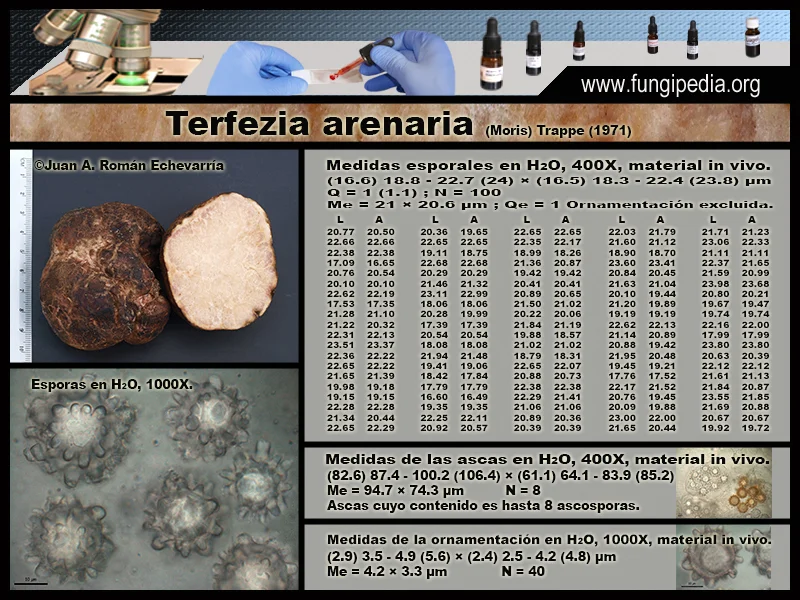
Fruiting body with the typical tuberculate shape of most hypogeous or semi-hypogeous species, resembling a potato that develops underground but emerges to the surface through soil cracks upon maturity. It may be somewhat oblong or spherical with occasional protuberances, with this species typically exhibiting somewhat turbinate (top-shaped) forms featuring an acute sterile base. It is among the largest species within its genus; size is variable, ranging from small specimens to some reaching 15 cm in diameter, typically between 3 and 8 cm. When buried, they are cream-colored with pinkish or rusty tinges, darkening upon maturity to brown tones.
Peridium prosenchymatous with hyaline hyphae arranged more or less parallel, though sometimes somewhat irregular. It is slightly thicker than in some related species, measuring approximately 3 mm thick. Clearly distinguishable from the gleba in cross-section, although it does not separate easily from it. Cream to brown at maturity and pinkish when cut; it is common in this species for the peridium of older specimens to crack, revealing the gleba.
Gleba compact and fleshy, whitish with a pinkish tinge in immature specimens, gradually darkening to brown or reddish-brown tones upon maturity. Lacks cavities but features sterile veins that persist until the end and are generally lighter in color than the fertile portion. Produces more or less globose, sac-like asci containing up to 8 spores each; the spores are spherical and heavily ornamented with apically truncated warts, giving them a gear-like appearance. See our microscopy section for details.
Flesh which is essentially the gleba itself, quite firm and hard, with a mild, pleasant odor and a similar taste.
Habitat:
This species fruits from late winter well into spring; in some areas it appears as early as March, with April and May being the most favorable months. It typically grows solitarily, although in some regions it forms clusters. It prefers acidic soils and is always associated with the plant commonly known as "madre de la criadilla", Tuberaria guttata. Its productivity heavily depends on late autumn and winter rainfall; in some years it is very abundant, while in others it is scarce. It is hypogeous when immature, but causes soil cracking and emerges to the surface upon maturity.
Observations:
A species commonly collected and consumed in certain peninsular regions, such as Extremadura or Andalusia, although it is quite localized and absent from other areas. It is a good edible and shares morphological similarities with other congeneric species inhabiting the same habitat, such as Terfezia leptoderma, Terfezia extremadurensis, or Terfezia magnusii. The latter forms mycorrhizae with Cistus species (rock roses), not with Tuberaria, and is more whitish. It can be readily distinguished from the other two in cross-section, as their peridia are only a few micrometers thick, whereas in Terfezia arenaria it reaches up to 3 mm. They are also easily distinguished microscopically, as both possess spiny rather than warty spores.
Microscopy of Terfezia arenaria