Tectella patellaris
Taxonomy
Main synonym
Common names
Panellus velado
Geographic references:
Interactive map with data from GBIF.




Morphological Features:
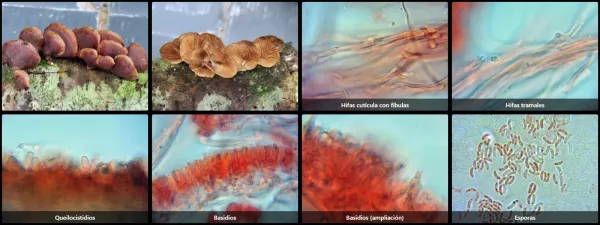
Pileus small in size, with an average diameter not exceeding 2 cm; specimens from our collection reached a maximum of 3 cm. Initially concave, soon becoming cup-shaped or cyphelloid. Its surface is fairly uniformly ochraceous, generally rather pale, especially upon drying. Despite containing a gelatinized layer, it feels tomentose and smooth to the touch, perhaps slightly farinose. It may bear remnants of the veil, particularly near the margin. The margin is regular and incurved, especially when young, and may be floccose, being little to not at all striate.
Lamellae radiating from a central point towards the periphery, very crowded and dense. Fundamentally ochre in color but with varying reflections or shades: yellowish when young, later reddish, finally brown, despite the spore print being white with a grayish tinge. Very young specimens possess a membrane that completely protects them; this membrane tears away and eventually disappears or remains as floccose remnants attached to the pileal margin.
Stipe lateral and highly rudimentary, short; it is more accurately described as a pseudostipe, as it can be considered a mere extension of the pileus adhering to the substrate, with no chromatic difference between the two parts.
Flesh thin, similar in color to the pileus or slightly more yellowish. Somewhat tenacious when young and extremely hard upon drying, leaving the basidiocarp mummified-like. Lacks a significant odor; the taste is rather strong and unpleasant.
Habitat:
A clearly lignicolous species that fruits on dead wood of various trees. It is a rare species worthy of protection, uncommon on broadleaf trees and even rarer on conifer remains. Despite its rarity, where it occurs it typically fruits in more or less numerous groups colonizing the wood. Our collection was made in Navarre, on fallen branches of Corylus avellana, co-occurring with Plicaturopsis crispa. The group consisted of numerous specimens, all mature and lacking a veil covering the lamellae, collected in March.
Observations:
An interesting species that should be considered rare or uncommon, characterized by its lignicolous habitat, radiating lamellae protected by a veil that tends to disappear, and a white spore print. Due to the special configuration of its lamellae, it may be confused with species of the genus Crepidotus, but those have an ochre spore print rather than white. It is more difficult to separate from some Panellus species when, as in our case, all specimens are found without a veil, particularly Panellus ringens, which is very similar. Macroscopically, it can be distinguished because the latter is much more striate, but their minor differences are primarily microscopic, such as the absence of cystidia or slight variations in spore size.
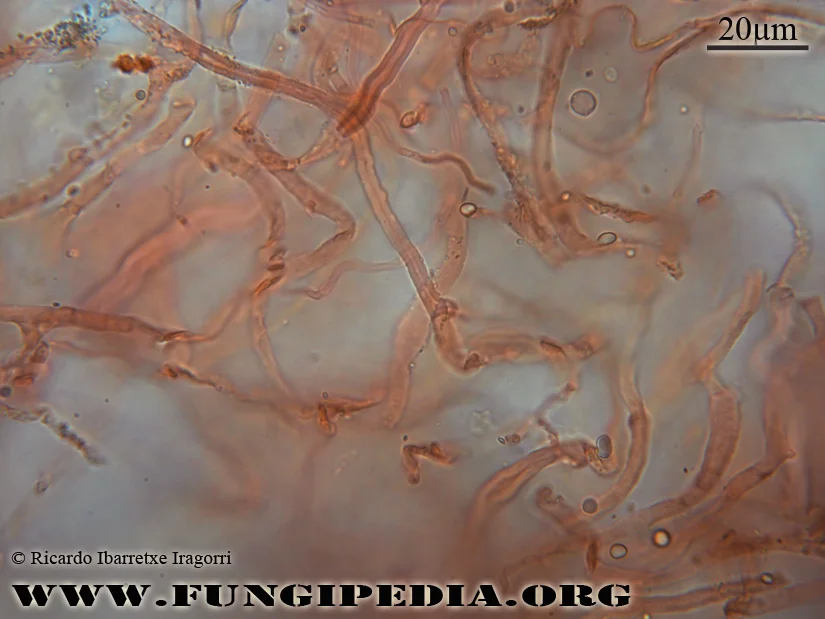
Microscopy of Tectella patellaris