
Tarzetta cupularis
Taxonomy
Main synonym
Common names
Peziza pálida.
Geographic references:
Interactive map with data from GBIF.



Morphological Features:
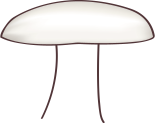
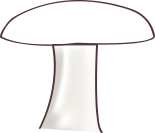
Basidiocarp bowl- or cup-shaped, lacking a stipe, of small dimensions, reaching at most 2 to 3 cm in diameter by the same height. Its external surface is yellowish-ochre to olivaceous, sometimes with grayish tinges, and is typically furfuraceous. The margin is toothed or serrate.
Hymenium completely smooth, lining the internal surface of the basidiocarp, dirty white with yellowish tinges.
Stipe practically absent; occasionally a slight stipe may be present, but it is entirely buried and barely perceptible.
Flesh scant and fragile, with no remarkable odor or taste.
Habitat:
This species typically fruits in spring, though it may also be encountered in autumn. It fruits in parks or gardens and under various trees; in our case, it was found in spring beneath lime trees.
Observations:
This fungus bears a certain resemblance to Tarzetta catinus, and some authors even tend to synonymize them; however, apart from their broader spores, we consider that they also differ macroscopically. The species described here is smaller, exhibits yellowish or olivaceous tones lacking in the other, and furthermore, the stipe of the latter is more conspicuous to the naked eye.