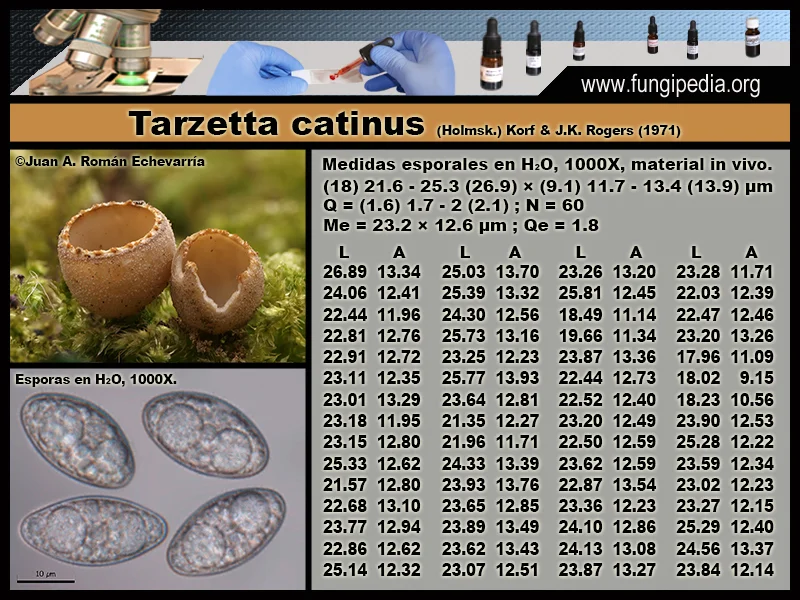

Tarzetta catinus
Taxonomy
Main synonym
Common names
Peziza pálida.
Geographic references:
Interactive map with data from GBIF.





Morphological Features:
Fruiting body cup-shaped, reaching 3 to 4 cm in diameter at the upper margin. Its external surface is creamy-ochre and finely pubescent. The margin typically exhibits a toothed or serrated appearance, though these teeth usually do not come to a sharp point. It rises only 2 to 3 cm above the ground.
Hymenium lining the inner surface of the fruiting body, concolorous, and completely smooth.
Stipe highly rudimentary, barely perceptible.
Flesh scant and fragile, without any distinctive odor or taste.
Habitat:
Typically fruits from spring onwards on bare soil devoid of vegetation, occurring indiscriminately in various forest types, both broadleaf and coniferous.
Observations:
This species is characterized by maintaining its cup shape without expanding flat like certain apothecia, and it features a serrated margin; it can be found as early as spring. However, there is a species with similar characteristics that is difficult to distinguish from the one described here, Tarzetta cupularis, which exhibits more olivaceous tones and is smaller in size.
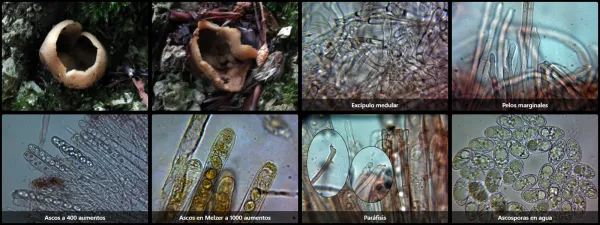
Microscopy of Tarzetta catinus