
Suillus luteus
Taxonomy
Main synonym
Common names
Boleto anillado, pinudi-onddo likin, pinetell de calceta.
Geographic references:
Interactive map with data from GBIF.


Morphological Features:
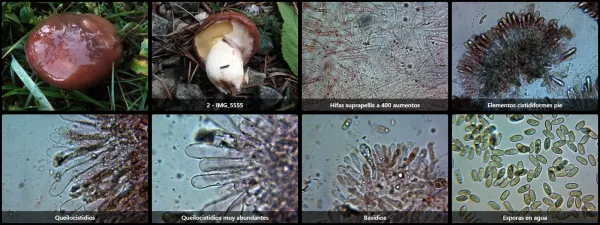
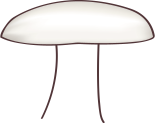
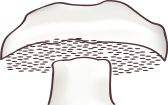
Pileus reaching over 10 cm in diameter, initially convex, maintaining this shape for a prolonged period before eventually flattening. Dark brown, particularly when young, though it acquires ocre-yellowish tones upon drying. The surface is highly viscid due to a mucilaginous pellicle, which sometimes imparts a purplish hue, and is easily separable from the pileal flesh. The margin is fairly regular and frequently retains remnants of the partial veil when young.
Tubes adnate to slightly decurrent, quite long, pale yellow, darkening to olivaceous tones with age. Unchanging in color, as is typical for all Suillus species.
Pores small and angular, yellow, slightly brighter than the tubes.
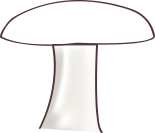
Stipe cylindrical and typically short or proportional to the pileus size, pale yellowish and granular above the ring, browner towards the base. The ring is white above and violaceous below; over time it becomes adherent to the stipe or tends to disappear.
Flesh thick but tender, soft, slightly more fibrous in the stipe, pale yellow, unchanging. Nothing significant can be noted regarding odor or taste.
Habitat:
A very common species in our pine forests, where it can form extensive carpets in certain years, particularly during autumn.
Observations:
Undoubtedly the most culinarily valuable among Suillus species, its flavor is excellent, though unfortunately its texture does not quite match. For consumption, the pileal cuticle must be discarded as it is mucilaginous and can induce diarrhea; we are aware of cases where individuals avoided constipation by consuming them with the skin intact. It is frequently confused with Suillus granulatus, with which it shares a habitat, particularly if the ring has been lost, but such misidentification poses no danger.