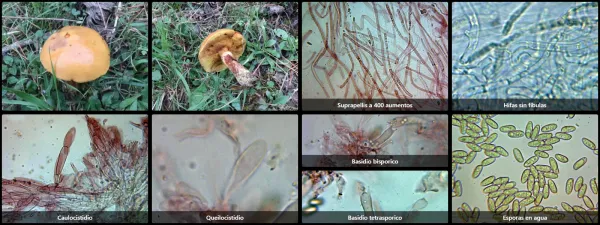
Suillus grevillei
Taxonomy
Main synonym
Common names
Boleto elegante, ondo apain.
Geographic references:
Interactive map with data from GBIF.




Morphological Features:
Pileus of a striking bright yellow color, occasionally with orange or brownish blushes. It can reach up to 10 cm in diameter and is highly viscid, especially in rainy weather, when it may become even sticky. Somewhat bell-shaped when young, it becomes convex before flattening with age. Its margin is fairly regular.
Tubes adnate, long and narrow, golden-yellow in color, a hue that persists almost until the specimen ages, becoming olive only late in development.
Pores small and rounded, bright yellow when young, becoming angular and dull olive as they age. They stain slightly upon handling but do not bruise blue.
Stipe up to 10 cm long, cylindrical and rather slender, yellowish with more pronounced brownish zones in mature specimens. In young specimens, it bears a membranous veil extending from the pileus to the stipe, which develops into a yellowish, mucilaginous ring that tends to persist as a mere annular zone in age.
Flesh yellow in color, more compact when young but quickly becoming soft and spongy. It may stain slightly gray upon handling but does not bruise blue. Odor faintly fungal; taste pleasant.
Habitat:
It may appear from summer onwards, but fruits profusely in autumn. It is a species that forms mycorrhizae with larches, under which it often forms extensive carpets.
Observations:
The flesh of this mushroom becomes soft and spongy, making it a mediocre edible; if consumed, its mucilaginous cuticle should be removed prior to preparation. The bright yellow coloration of the entire fruitbody, its viscosity, and its exclusive habitat under larches make it virtually unmistakable. Boletus flavus resembles it somewhat, but is duller in color, has wider pores, and tends to bruise blue.