
Suillus collinitus
Taxonomy
Main synonym
Common names
Not available
Geographic references:
Interactive map with data from GBIF.
Morphological Features:
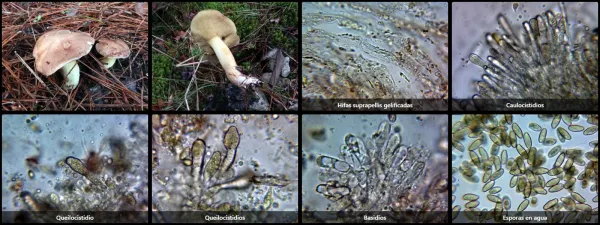
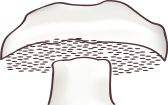
Pileus of medium size, between 5 and 10 cm in diameter, initially subglobose becoming convex, eventually flattening out, and even slightly depressed at the center in older specimens, with the margin more uplifted. Its surface is relatively viscid, especially during rainy periods, and fibrillose. Against a chestnut-brown background, the fibrils give it a darker, even brownish appearance. The cuticle separates easily from the pileal flesh.
Tubes elongated, yellow, adnate, unchanging in color, a characteristic common in Suillus.
Pores regular, yellow, broad, becoming darker with age.
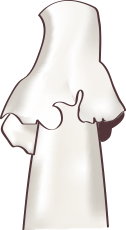
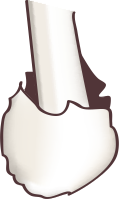
Stipe which can be considered robust for a Suillus, generally cylindrical, though sometimes tapering at the base. It is pale yellow in color and bears granulations of the same hue that turn brownish over time. The mycelial attachment imparts a pinkish tint to the base, a feature that is not always present.
Flesh pale yellow, quite thick but spongy, especially when old. It is unchanging upon cutting, with a faint odor and a sweet, mild taste.
Habitat:
It appears mainly during autumn, although occurrence in other seasons cannot be ruled out. Although not as abundant as other Suillus species, it is commonly found in pine forests of Mediterranean climates.
Observations:
As an edible mushroom it is rather mediocre, although it can be consumed if nothing better is available, provided the cuticle is removed. This species is frequently confused with Suillus granulatus and Suillus mediterraneensis; however, its cuticle is darker and more fibrillose. Differentiating the latter two from each other is more difficult.