

Suillus bellinii
Taxonomy
Main synonym
Common names
Boleto pringoso, baboso, Bellini pinudi-onddo, moixí.
Geographic references:
Interactive map with data from GBIF.




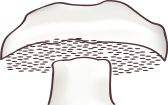
Morphological Features:
Pileus with a diameter in mature specimens ranging from 5 to 10 cm, occasionally up to 15 cm. Initially hemispherical at emergence, becoming first globose, then convex, and finally expanded. The cuticle is easily separable from the flesh, smooth, initially whitish or cream-colored but maturing to an ochraceous hue with brownish or clay-like tints; it is rarely uniform in color, instead displaying alternating lighter and darker zones, appearing nearly white in shaded areas. Surface viscid and greasy, readily adhering leaves or small twigs. The margin is regular and typically even.
Tubes not easily separable from the flesh, short, and yellow when young, later turning dark beige or olivaceous.
Pores rather small, round to angular, initially nearly white or pale yellow, later becoming more yellow and maturing to a dirty beige; they exude milky droplets when young.
Stipe typically short, somewhat stout in immature specimens, cylindrical and more elongated in mature specimens, solid, ivory-colored with granulations that may be reddish or dark.
Flesh thick and white, more yellowish beneath the tubes; relatively firm in young specimens but softens rapidly. Odor indistinct; taste sweet and mild.
Habitat:
This species forms mycorrhizae exclusively with conifers, particularly pines, showing a special predilection for Pinus pinaster. Fruiting typically occurs in more or less numerous groups, appearing in spring or primarily during autumn. A common species, locally very abundant.
Observations:
Very young specimens constitute an acceptable edible, provided the precaution is taken to remove the cuticle, which may have a laxative effect; however, the flesh softens easily and mature specimens lack culinary value. It sometimes shares habitat with Suillus collinitus, a species with a distinctly fibrillose cuticle and a more homogeneous dark coloration, whose stipe base acquires pinkish tints. It may also resemble Suillus granulatus, which is less viscid and has a lighter, more uniform coloration, and particularly the rare species Suillus placidus, which has a whitish cuticle and inhabits five-needle pines.