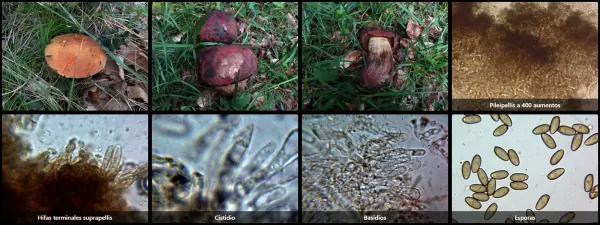

Suillellus queletii
Taxonomy
Main synonym
Common names
Boleto de quelet.
Geographic references:
Interactive map with data from GBIF.


Morphological Features:
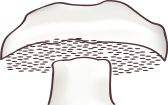
Pileus in the adult state between 10 and 15 cm in diameter, initially hemispherical, becoming convex, and finally expanding without fully flattening. Its color is variable, as it may be brick-red, orange-brown, and exhibit different color tones within a single specimen. It is not viscid but dry, and its external surface is smooth or finely pubescent, especially when young.
Tubes yellowish and later olivaceous, perfectly separable from the pileal flesh, of somewhat variable length, making it difficult to define whether they are long or short.
Pores yellowish when the specimen is emerging, quickly turning orange, and finally reddish, although they tend to be more yellowish near the pileal margin. They change color upon pressure to greenish-blue tones.
Stipe cylindrical, generally broadened in the central region and attenuated at the base, although sometimes more uniform. Its color is yellow, occasionally with orange tones, and it is smooth, lacking any reticulation, and only dotted red in var. rubicundus. The main characteristic is the vinous-red color it adopts at the base.
Flesh thick and compact, yellow throughout its surface except at the stipe base where it is dark red. It bruises rapidly and intensely to navy-blue tones upon cutting. Odor mild and fruity, taste slightly acidic when raw.
Habitat:
Fruiting in summer and especially in autumn, more commonly found in deciduous forests, it occurs in both beechwoods and oakwoods. It is a relatively frequent species.
Observations:
The variability in pileal color led some authors to recognize several varieties, such as Boletus queletii var. lateritius, with a brick-red cap. Boletus queletii var. rubicundus is sometimes caespitose and has a much redder stipe than the type species, although currently all of them are synonymized under the same taxon, Suillellus queletii. It can be easily confused with Boletus erythropus, which has a brownish pileus and a distinctly red-dotted stipe, as well as with Suillellus luridus, which has a reticulate stipe, or with the toxic species Suillellus satanas, characterized by a whitish pileus and white flesh.