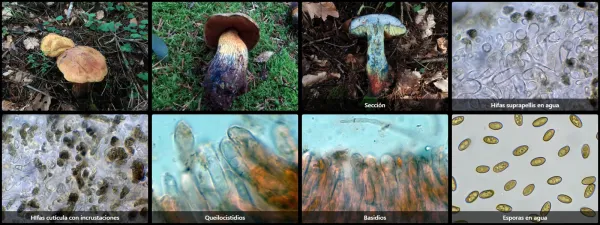

Suillellus luridus
Taxonomy
Main synonym
Common names
Boleto cetrino, hongo de vaca, onddo zikin, mataparent de peu reticulat.
Geographic references:
Interactive map with data from GBIF.

Morphological Features:
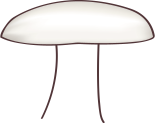
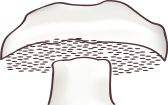
Pileus up to 15 cm in diameter, hemispherical when young, later becoming convex. Color is highly variable, always within ochre and olivaceous tones, sometimes with reddish hues, making it irrelevant for accurate identification. The surface is finely tomentose or pubescent, even velvety in young specimens.
Tubes initially yellow, later becoming olivaceous, easily separable from the pileal flesh, free from the stipe.
Pores round and rather small, bright red with an orange hue, staining very dark blue upon touch.
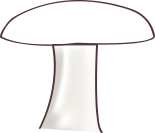
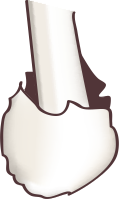
Stipe thick and cylindrical, generally shorter than the pileus diameter, yellow in color but covered with a reddish-orange reticulum that occupies its entire surface.
Flesh markedly yellow in color, except for the subhymenial surface (beneath the tubes), where it is reddish-orange. When cut, it initially turns greenish-blue and subsequently to indigo blue. It is thick and quite compact, with a faint odor and a pleasant taste.
Habitat:
Fruiting occurs in various forest types, with a preference for deciduous woods on calcareous soils. From late summer through autumn. Frequent, though not as abundant as other Boletus species within its section.
Observations:
Edible and good-tasting, but dangerous when raw, especially when consumed with alcoholic beverages. It is the prototype of a somewhat complex section within the genus, encompassing numerous species, some of which are closely related and difficult to differentiate. It is frequently confused with Boletus erythropus, which lacks a stipe reticulum, and with Suillellus queletii, which has a smooth stipe that is vinous-red at the base; however, the most similar species is Suillellus caucasicus, which is also reticulate but features a yellow subhymenial surface. The toxic species Suillellus satanas has a whitish cuticle and exhibits a weaker blue staining reaction.