

Rubroboletus dupainii
Taxonomy
Main synonym
Common names
Boleto de Dupain.
Geographic references:
Interactive map with data from GBIF.




Morphological Features:
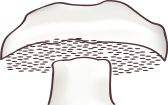
Pileus measuring 10 to 15 cm in diameter at maturity, initially convex, becoming somewhat flattened with development but retaining a degree of convexity. The color is certainly striking, blood-red or scarlet, only adopting yellowish tones in old age; it is also glossy and viscid. Margin fairly regular, occasionally slightly undulate.
Tubes moderately short, yellow in young specimens, later turning olivaceous, and bluing conspicuously when cut.
Pores orange in youth, but quickly turning red while retaining a slightly orange tint near the margin. Bluing faintly upon pressure.
Stipe cylindrical, central, and robust, slightly thickened at the base; yellowish in the upper portion, with the remainder red, sparsely or not at all reticulate.
Flesh pale yellow, fairly thick, possessing an intense but not unpleasant fruity odor and a slightly sweet taste. Bluing upon cutting.
Habitat:
Fruiting occurs from late summer through autumn. It has been collected in holm oak and oak forests, occasionally appearing in groups following early seasonal rains, though it remains relatively scarce.
Observations:
Within its section, it is undoubtedly the most conspicuous species, readily identifiable by its striking scarlet-red coloration. It may be confused with Suillellus queletii, whose stipe is red only at the base. Suillellus permagnificus, which is gregarious and exhibits a much more saturated red hue, may also bear some resemblance.