Leratiomyces ceres
Taxonomy
Main synonym
Common names
Not available
Geographic references:
Interactive map with data from GBIF.




Morphological Features:
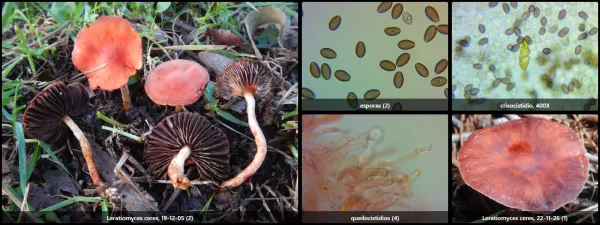
Pileus barely exceeding 5 cm in diameter, slightly conic at first, soon becoming convex and finally flattened, sometimes bearing an inconspicuous obtuse umbo, although we consider this a character that varies from specimen to specimen. The cuticle is smooth and shiny when wet, even viscid, but dries quickly; it is very striking in color, intense red. This surface usually bears whitish floccose remnants of the universal veil, which are labile and disappear with rain. The marginal zone is often somewhat whitish and also retains veil remnants.
Lamellae adnate and rather distant from each other, olivaceous cream in youth, later turning purplish-grey while retaining a slight olive tinge, and almost always with a paler edge.
Stipe generally slender and elongated, frequently curved, fistulose; whitish in young specimens and heavily adorned with floccose fibers, becoming more yellowish-ochraceous upon maturity while simultaneously becoming practically smooth. The upper portion may bear an annular zone that tends to disappear over time, and the base is commonly tinged with a beautiful reddish hue.
Flesh scant and somewhat soft, yellowish-white; it possesses little to no distinctive odor and its taste is similarly mild.
Habitat:
This is a species that, although rare in our area of study, has been observed to proliferate in recent years. We have located it in public gardens, both in planting beds and under magnolia trees, growing on horticultural substrate basically composed of various woody debris. It typically appears late in the season, in late autumn or, as in this case, winter, and is usually found growing in clusters.
Observations:
This species is fairly well recognized by its striking coloration, intense red on both the pileus and often at the base of the stipe, as well as by the transient nature of its annular zone. According to recent studies, the name Leratiomyces ceres has also been applied to an American species; in our understanding, it represents the same species. Its potential toxicity is under consideration, as is the case with other species of the same genus, so it would not be surprising if it contained toxic compounds.