
Stropharia rugosoannulata
Taxonomy
Main synonym
Common names
Sorgin handi-marroi.
Geographic references:
Interactive map with data from GBIF.
Morphological Features:
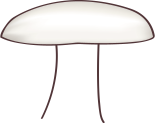
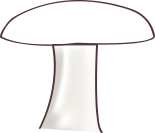
Pileus of notably large size for the genus to which it belongs; in its adult state, it can routinely exceed 10 cm in diameter, with specimens approaching 20 cm having been recorded. Initially subglobose, soon becoming convex and finally flattened. The cuticle is thick and can be separated from the flesh with some ease. It is fundamentally brown in color, but exhibits purplish-brown or reddish hues, especially in older specimens, and bears woolly flocculi in its early stages that disappear rapidly. The margin is incurved and woolly when young, becoming smooth and cracked in adult specimens.
Lamellae subfree, varying in color from initial gray to lilac, darkening with maturity to nearly blackish-purple tones. They are thin and fairly crowded, with the edge matching the color of the rest.
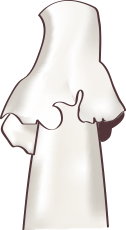
Stipe cylindrical, appearing robust and solid when young, later becoming hollow, sometimes with a bulbous base. It has a whitish background but is covered with some yellowish fibrils in young individuals, which turn ochraceous upon handling. It bears a persistent ring in the upper zone, white when young and edged with yellow.
Flesh thick and white, slightly more fibrous in the stipe, may exhibit yellowish tones at points of injury. Its odor is noticeable, ranging from fungoid to herbaceous, and its taste is sweet.
Habitat:
We typically locate it on a meadow in the Basque locality of Bedia (Spain); another reference habitat is along riverbanks and streams, near riparian trees, or in nitrogen-enriched ruderal areas. It is a very rare and scarce mushroom, difficult to find in the wild. Its preferred fruiting period is winter and early spring.
Observations:
This fleshy mushroom constitutes an acceptable edible and is currently cultivated for commercial purposes. Within the genus Stropharia, it is undoubtedly the most fleshy and largest species, as well as the only edible one, given that many others are toxic or even hallucinogenic. Leratiomyces squamosus var. squamosus bears some resemblance, but is smaller and has more persistent scales. Very old specimens with blackish lamellae could be confused with Agaricus sp.