
Stropharia inuncta
Taxonomy
Main synonym
Common names
Not available
Geographic references:
Interactive map with data from GBIF.


Morphological Features:
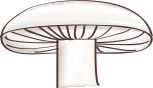
Pileus in developed specimens typically ranges from 2 to 4 cm in diameter, initially convex-campanulate, soon distinctly convex and finally flattened, retaining a raised or obtusely umbonate center. Cuticle glutinous during rainy periods, maintaining a certain viscosity even when dry, fundamentally grayish but with clear lilac or violet hues; the central umbonate zone is a darker ochraceous color than the rest. Easily separable from the flesh. Margin regular, appearing to extend due to the glutinous coating.
Lamellae adnate, moderately spaced, neither very crowded nor widely separated, rather broad and of varying lengths. In the initial stage of development, quite pale, whitish or cream-colored, but darkening over time due to sporulation, becoming brown or distinctly fuscous. The lamellar edge is typically paler, whitish.
Stipe cylindrical and elongated, potentially twice as long as the pileus diameter, pale in color, nearly white, unadorned, solid becoming hollow with age, tending to be sinuous in the lower third. Typically bears a distinct appressed ring in the upper third, which usually degrades into a mere annular zone.
Flesh thin, whitish, not very firm, with a pleasant fruity odor and a sweet taste.
Habitat:
A very poorly documented species occurring in grassy areas adjacent to forests. This account is based on two collections: the first, from Navarra in November 2016 (courtesy of our friend and collaborator Hector), at the edge of a calcareous pine forest, which we believe represents its first citation on the Iberian Peninsula; and a second collection, courtesy of Koldobika and Floren of Micolosa, in December of the same year in Álava, near a calcareous holm oak woodland. We therefore consider it a heliophilous species that fruits on soils with a basic pH. In both instances, small groups of specimens were observed.
Observations:
This is a very uncommon species characterized by its glutinous or viscid gray cuticle with clear violet tones, a pale whitish stipe that is unadorned and bears an appressed ring, and a heliophilous, calcareous habitat. Given these peculiarities, it is hardly confused with any other species. Stropharia albonitens may show some resemblance due to its glutinous cuticle, but can be readily distinguished by the lack of violet tones and its preference for acidic substrates.
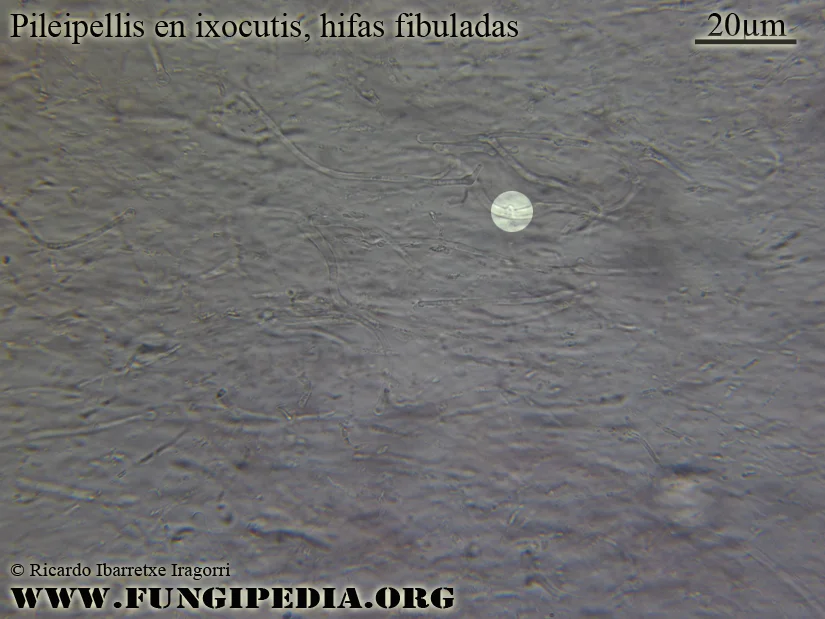
Microscopy of Stropharia inuncta