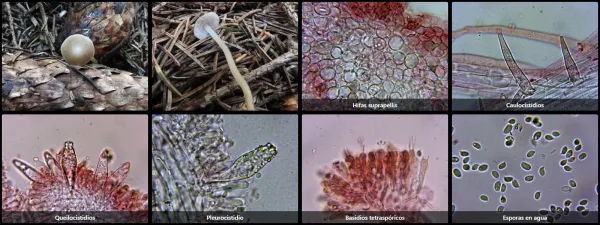
Strobilurus esculentus
Taxonomy
Main synonym
Common names
Collibia comestible.
Geographic references:
Interactive map with data from GBIF.




Morphological Features:
Pileus of small dimensions, reaching a maximum diameter of only 3 to 4 cm at full maturity. Convex in shape but tending to flatten with age. The cuticle is smooth or slightly rugose, ochre to light brown in color; occasionally bearing a small, barely perceptible umbo, but most often lacking it. The pileal margin is non-striate and typically incurved.
Lamellae white, becoming somewhat cream-colored at maturity, adnate to the stipe or slightly decurrent; not crowded but rather moderately spaced.
Stipe elongate relative to the pileus, ochre to reddish basally, paler towards the apex, slightly rooting at its junction with the mycelium.
Flesh scanty, whitish, quite tough, with a mild fungal odor and sweet taste.
Habitat:
It most often appears to grow directly on the soil, but in reality fruits on decaying cones of various spruce species, or simply buried, even partially buried. In our case, it was found on cones of Picea abies. It is an exclusively spring-fruiting species.
Observations:
This is a little-known spring edible species among enthusiasts that fruits in gregarious clusters. Its habitat on spruce cones distinguishes it from other similar species, such as Strobilurus tenacellus, which fruits on pine cones and develops a bitter taste after brief mastication, or Strobilurus stephanocystis, which is reddish-brown in color, has a sweet taste, and also fruits on pine cones.