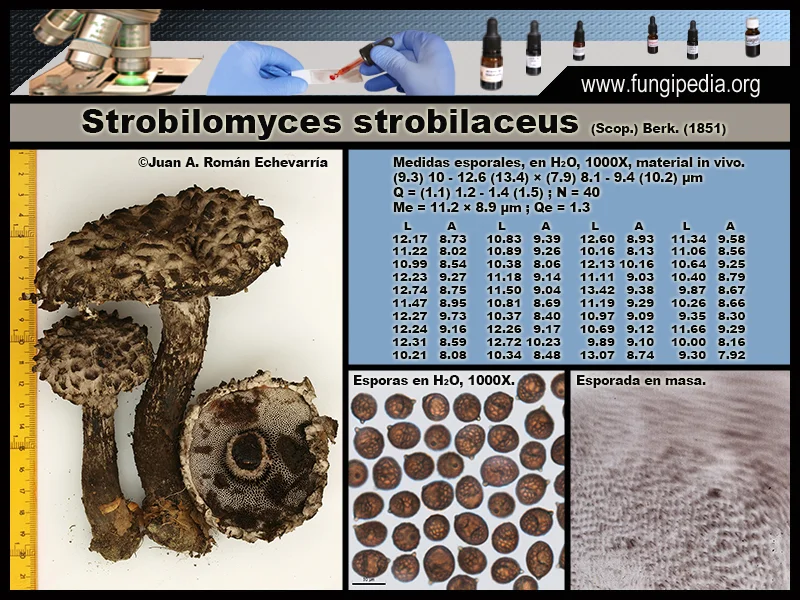

Strobilomyces strobilaceus
Taxonomy
Main synonym
Common names
Boleto escamoso, onddo eskatatsu, Mataparent d`escames.
Geographic references:
Interactive map with data from GBIF.


Morphological Features:
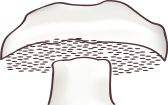
Pileus initially globose in the early stages of development, gradually expanding to become convex or plano-convex, without becoming fully flattened. It is notably large, potentially exceeding 10 cm in diameter; its appearance is highly peculiar, resembling pine cones, as it is covered with broad scales or tufts ranging in color from gray to black, revealing a whitish background. These scales are typically prominent and irregularly pyramidal. The margin is generally reflexed, floccose, and particularly in young specimens, often retains broad remnants of the partial veil.
Tubes quite long, initially dirty whitish but rapidly turning gray, relatively crowded and adnate to the stipe.
Pores large and angular, gray in color, covered by a fine partial veil that soon disappears; they stain darkish upon pressure, sometimes initially turning red.
Stipe central and cylindrical, with a fibrous appearance and hard consistency, often thickened toward the base. In young specimens, it is covered with floccose patches similar in color to the pileus, which tend to partially disappear over time. It is gray in color and tends to darken from the base upward.
Flesh thick and firm, with a coriaceous consistency, becoming woody in the stipe; pale gray in color. Upon cutting, it reacts by initially staining reddish, subsequently turning black. It has an unremarkable, neutral odor, slightly earthy, and a completely bland taste; furthermore, the texture of the flesh itself hardly invites consumption.
Habitat:
This is a relatively uncommon species and therefore deserves protection. It generally fruits in broadleaf forests, commonly observed in beech forests (Fagus sylvatica), or also under Quercus pyrenaica; it is also recorded under Castanea sativa. It typically appears solitary or in small groups; we have only once observed it forming fairy rings. Its preferred fruiting period is summer to early autumn, as it is a species poorly tolerant of cold temperatures.
Observations:
Due to its highly peculiar appearance, with a pileus resembling pine cones, woody flesh, and its tendency to stain first red then black upon cutting, it is an absolutely unmistakable species. Porphyrellus porphyrosporus is another rare species with grayish tones and a strange appearance, but its pileus is smooth. This species appears on the Red List of threatened species in numerous countries and therefore must be protected. The consistency of the flesh renders it inedible.
Microscopy of Strobilomyces strobilaceus