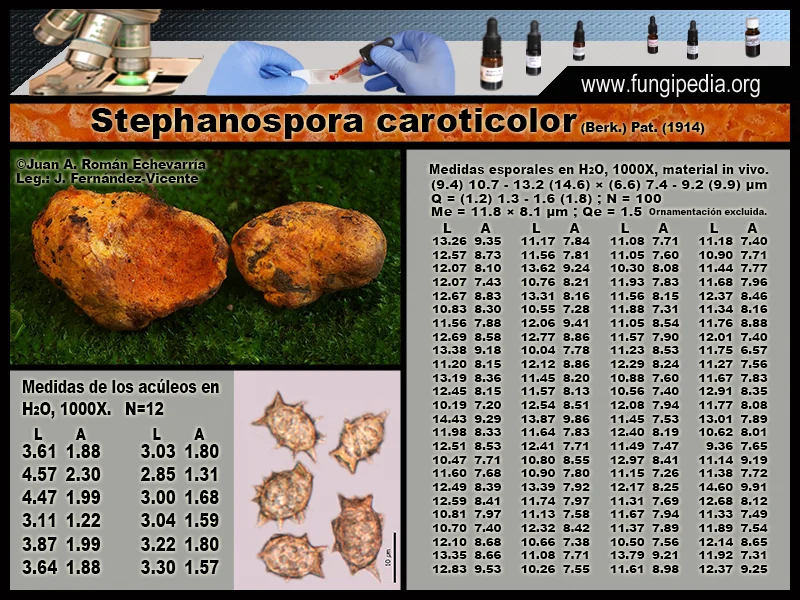
Stephanospora caroticolor
Taxonomy
Main synonym
Common names
Not available
Geographic references:
Interactive map with data from GBIF.





Morphological Features:
Basidiocarp presenting a small potato- or tuber-like shape, more or less globose to oblong; however, as is common in this type of species, it is quite irregular, frequently bearing lobes or protuberances that give it a somewhat imperfect appearance. It is a species of reduced size, with a diameter generally ranging between 1 and 3 cm, occasionally deviating from this range. It stands out remarkably for the beauty of its striking predominant orange coloration, which becomes reddish or darker in bruised or handled areas, and sometimes when young exhibits a yellowish pruina that disappears very easily. It typically lacks mycelial cords at the base and does not usually exhibit an apparent basal cavity.
Peridium with an external arachnoid layer formed by thin-walled, branched, septate hyphae, and an endoperidium composed of globose cells, very thin, fragile, and evanescent. Its initial pale color quickly turns to yellowish-orange or distinctly orange tones with slightly reddish areas; upon disappearing, it reveals the underlying gleba.
Gleba composed of numerous tightly packed chambers that tend to elongate somewhat upon maturation. Its color is generally more striking than that of the peridium, varying according to the specimen's maturity stage, from a matte yellowish-orange to a reddish-orange in older specimens. The absence of a columella in this species is noteworthy.
Flesh not differentiated from the gleba, with a somewhat spongy and fragile consistency. Its odor when young is fruity, but over time it acquires an excessive intensity that can become unpleasant. Its flavor is not particularly strong but is also unpalatable.
Habitat:
This species exhibits hypogeous growth when young, but over time and upon maturation, it typically emerges to the surface in a semi-hypogeous manner. Despite not being a heavily referenced species, it is remarkably cosmopolitan, as disparate habitats have been reported for it, ranging from open fields to various types of trees, including both conifers and broadleaf forests. The specimens studied herein were provided by Javier Fernández Vicente and were located under Fraxinus excelsior and Corylus avellana in Orduña (Bizkaia). It is a species that typically fruits in groups wherever it occurs and shows no preference for a specific season, as collections have been made from July through January.
Observations:
Macroscopically characterized by its beautiful orange coloration, particularly of the gleba, and easily identifiable microscopically due to its peculiar spores crowned with spines, as can be observed in our "microscopic features" section. Despite its attractive appearance, it is entirely discarded from a culinary standpoint due to its strong odor, unpleasant taste, and because it acts as a precursor to certain chlorinated toxic compounds under specific circumstances. Historically placed within the genus Hydnangium, with which it shares macroscopic similarities, such as Hydnangium carneum, which exhibits pinkish tones, an exclusive habitat under eucalyptus trees, and distinct microscopic features.
Microscopy of Stephanospora caroticolor