
Stemonitis fusca
Taxonomy
Main synonym
Common names
Not available
Geographic references:
Interactive map with data from GBIF.



Morphological Features:
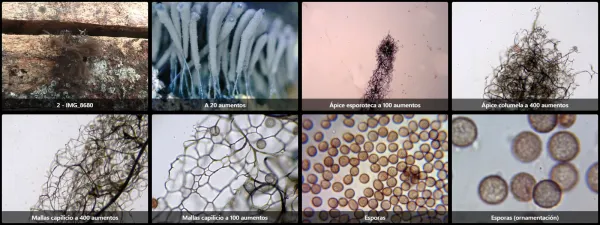
Plasmodium of the aphanoplasmoidal type, formed by fine, transparent filaments that join to form a network. It possesses compact veins in which distinct parts or regions are not differentiated, being pure white and translucent. It grows as it moves, leaving a mucous trail known as a hypothallus. This hypothallus aggregates into spherical masses, resembling small clustered white beads, marking the completion of its somatic phase; from that point onward, it ceases movement and begins the formation of reproductive bodies or sporocarps.
Sporocarps form clusters of numerous individuals growing in parallel but individually. Within the spherical masses, a stipe develops from the hypothallus, gradually rising and lifting the protoplasm upward, which in turn internally supports further stipe elongation. During this process, the white color of the plasmodium is maintained; however, as maturation begins, a peridium forms, enclosing the capillitium fibers within. Through meiosis, the protoplasm generates spores that are deposited among the capillitium fibers. Throughout this overall developmental process, the color varies according to the degree of maturation, progressing from gray to black, and finally becoming dark brown. Internally, a columella runs the entire length of the sporocarp, serving as an anchor for the capillitium fibers. The entire structure can reach an approximate height of 2 cm.
Stipe emerges white and eventually turns black, occupying only the lower portion of the reproductive bodies, comprising merely one-fifth of the total height.
Habitat:
This Myxomycete shows no preference for a specific season and may appear practically year-round provided conditions are optimal. It fruits on dead wood of various trees under high humidity conditions. It is one of the most frequently encountered species within its genus.
Observations:
Within the Myxomycetes, Stemonitis species are exosporous and are characterized by forming fruiting bodies consisting of numerous clustered individuals that grow in parallel, resembling a single entity. Many other similar species exist within the genus, such as Stemonitis axifera, which possesses a more reddish capillitium; however, definitive differentiation requires detailed microscopic examination.