
Sparassis crispa
Taxonomy
Main synonym
Common names
Seta coliflor, azalore belaki, peu de rata reina, greixa reina.
Geographic references:
Interactive map with data from GBIF.
Morphological Features:
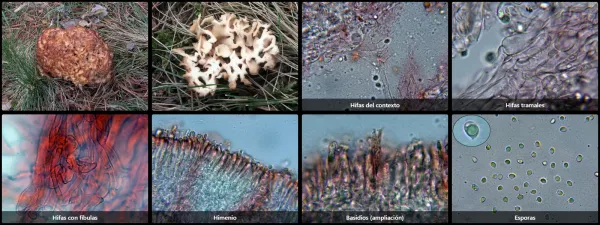
Fruiting body that can reach considerable dimensions, with some specimens measuring up to 40 cm in length by 20 to 25 cm in height. It consists of multiple crowded and interwoven branches, wavy or crisped, forming a compact mass resembling a cauliflower. The surface of these branches is cream-colored in young specimens, turning yellowish-ochre with age. Upon senescence, the branches spread and untangle, adopting a more lamellate or spatulate appearance.
Hymenium smooth, whitish to cream-colored, darkening gradually, particularly upon spore maturity. Produces smooth, more or less ovoid spores with a large lipid droplet, measuring approximately 5 to 7 µm by 4 to 5 µm.
Stipe very short, whitish, resembling a cauliflower stalk from which the branches arise; when the fruiting body is fully developed it is not visible, and the specimen appears sessile.
Flesh thin and fragile, white turning yellowish-ochre; odor aromatic and very pronounced, slightly anise-like when fresh, later becoming complex and sweetish; taste reminiscent of nuts. Soft when young, later becoming more leathery.
Habitat:
Typically associated with the base of trunks and stumps of various conifers, often growing directly on the surrounding soil or on roots. Fruiting occurs preferentially in autumn or late summer. In northern Iberia it is common under pines, where it appears reliably each year; however, it is scarce in other regions.
Observations:
Opinions vary regarding the culinary quality of this species; each forager must judge for themselves. We recommend collecting only young specimens in perfect condition, as it becomes somewhat indigestible with age. When young, the species is unmistakable; however, upon senescence it may be confused with Sparassis laminosa, which has a chlorinated odor and grows under broadleaf trees. Sparassis brevipes, also found under broadleaf trees, is even rarer.