
Sowerbyella imperialis
Taxonomy
Main synonym
Common names
Not available
Geographic references:
Interactive map with data from GBIF.


Morphological Features:
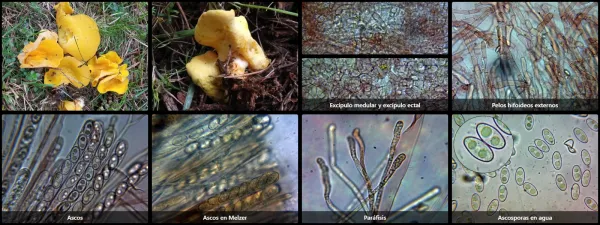
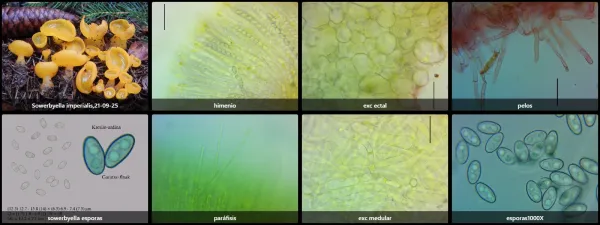
Fruitbody that from an early stage adopts a fairly regular concave shape, or may also be cup-shaped, only occasionally opening laterally. The upper zone is therefore the widest, with a diameter ranging from 2 to 4 cm. The exciple, the outer layer of the fruitbody, in young and well-hydrated specimens is a fairly vivid sulfur-yellow; over time it adopts duller tones, turning whitish upon drying. It is smooth and finely pruinose. The margin is smooth or slightly crenulate and not as regular as the rest of the ascocarp.
Hymenium smooth, immersed in the inner surface of the fruitbody, vivid yellow and much more persistent than the exciple; it produces ellipsoidal ascospores that are vaguely verrucose, containing up to two lipid droplets.
Stipe evident and conspicuous in most specimens; it generally goes unnoticed as it is immersed in the substrate. It may reach a length similar to the diameter of the upper zone, being rounded and solid.
Flesh inconspicuous, yellow in color; brittle in the upper portion and more elastic in the stipe. It lacks a perceptible odor and is tasteless.
Habitat:
This is an ascomycete very poorly documented in the literature due to its rarity; several possible habitats have been reported for it. Our collection was made in the vicinity of Lawson Cypress, also known as false cypress (Chamaecyparis lawsoniana). It has been found in autumn, specifically in November, in groups of numerous specimens, thus indicating a gregarious growth habit.
Observations:
A species that upon discovery resembles Peziza, with which it is related, differing from them by the presence of an evident stipe in most specimens. It is characterized, especially in young, well-hydrated specimens, by the uniformity of its beautiful yellow coloration in both the exciple and hymenium. Sowerbyella rhenana= Aleuria splendens, is a similar species, more orange in color, reminiscent of Aleuria aurantia. The separation from Sowerbyella radiculata is more controversial; this species is distinguished by its duller yellowish-ochre coloration, the absence of a differentiated stipe, and coarser spore ornamentation.